Data centers have been one of the biggest news stories of the past year. Last month, my colleague Rob wrote about this trend: everyone is talking about data centers. For community members, worries about the environment, electricity prices, and societal change have become widespread. For developers and investors, the exponential growth of data centers across the United States is generating excitement.

In Ohio, data center construction has received a lot of pushback from local residents. Many people don’t want to see more data centers being built near their homes. For instance, in Columbus, residents are urging local lawmakers to require large data centers to submit water conservation plans and create decommissioning plans. Some data center proposals have been rejected across the state and many communities are considering pausing data center development entirely (a proposal we asked Ohio economists about a few months ago).
Earlier this week, the Ohio Environmental Protection Agency announced it would not move forward with a permit that would have allowed data centers to discharge wastewater into natural water sources after receiving more than 7,000 comments on the proposal from the public. With all of this talk about data centers, I wanted to take a deeper dive into the existing and proposed data centers across the state. What kind of facilities already exist, and where are they located?
Where are data centers in Ohio?
Using data from DataCenterMap and Cleanview, we compiled a list of all existing and proposed data centers across Ohio. We found that there are 151 existing data centers in Ohio and an additional 143 data centers that have been proposed or are in development. We count each building as a separate data center, meaning that for larger data center campuses that include multiple facilities, each building is being counted separately. Below is a map of where the existing and proposed data centers are across Ohio. Seven planned data centers are omitted from the map due to insufficient data about the locations of these facilities.
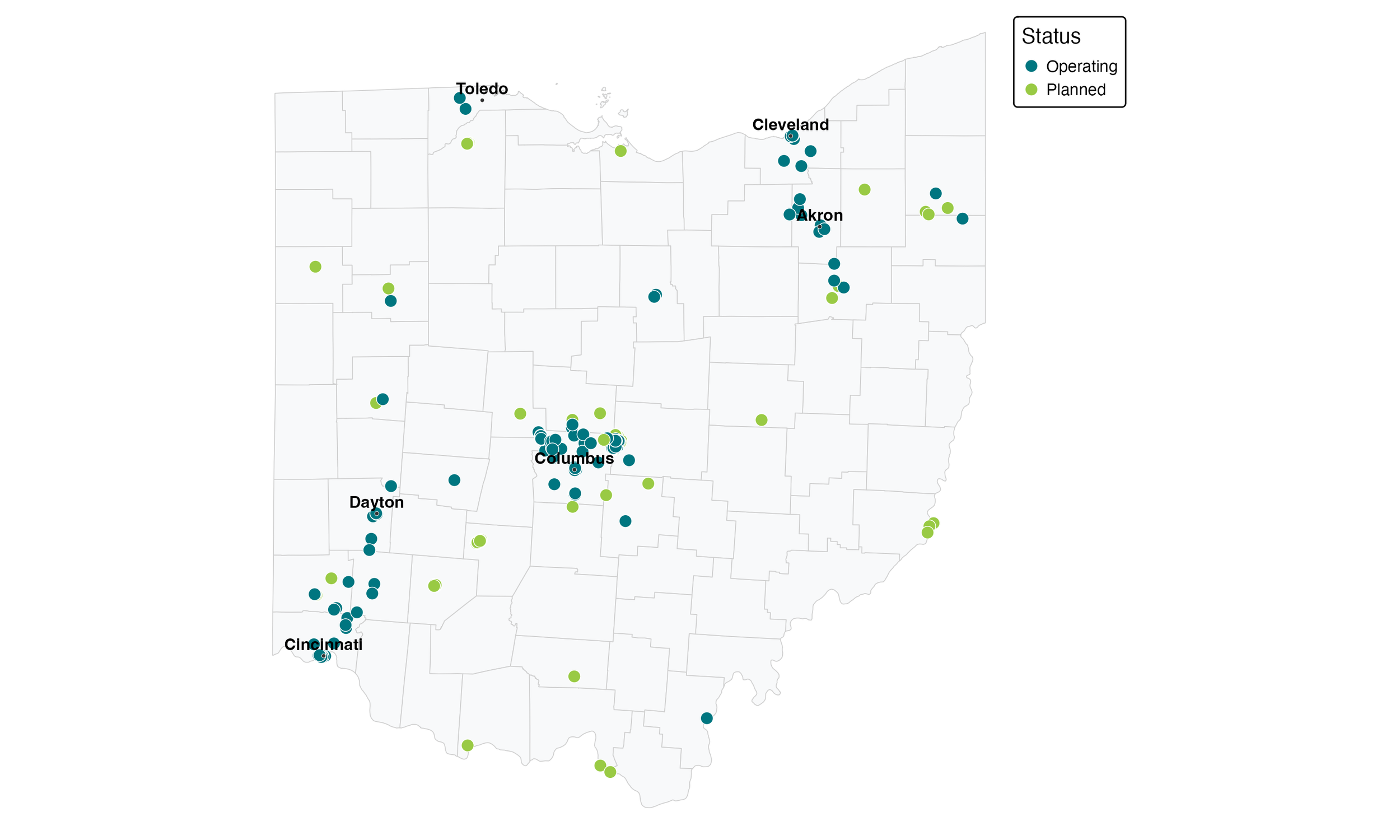
Data centers are most concentrated in Licking County and Franklin County in Central Ohio, where there are 66 and 64 existing and planned data centers respectively. Franklin County has a lot of existing facilities, a total of 50, while 38 of the 66 facilities in Licking County are planned or proposed. 23 of the 38 planned facilities in Licking County are from Amazon Web Services alone. Between 2015 and 2024, Amazon invested $6.2 billion in its Amazon Web Services data center infrastructure in Licking County.
The next largest county for data centers in Ohio is Fayette County, home to Washington Court House and Jeffersonville. Fayette County doesn’t have any existing data centers, but has 23 planned and proposed data centers. All 23 of these data centers are from Amazon Web Services, for a total of nearly 1,800 megawatts of power (which would power 1.44 million homes, 125 times the number of households in Fayette County). Early last year, Amazon purchased 590 acres of land in Fayette County for just over $100 million to build these 23 facilities. They are expected to be completed within the next one to four years.
Similar to Fayette County, Portage County, home to Kent, Ravenna, and Streetsboro, has no existing facilities but 14 planned data centers. All 14 facilities will be part of one campus in Shalersville run by Bitdeer, a cryptocurrency mining and artificial intelligence cloud infrastructure company. The Bitdeer campus will be at least 650 megawatts (which would power 520,000 homes, 8 times the number of households in Portage County) and 257 acres of land. Bitdeer is expected to open its first two facilities in 2029 and the remaining 12 facilities in 2031.
How fast are data centers growing in Ohio?
The first data center in Ohio opened in 1966. Through the twentieth and early twenty-first century, data center growth was steady. Starting in 2017, data center growth became exponential. For reference, the first large language model (the first GPT model from OpenAI) was released in 2018, and ChatGPT released publicly in 2022.
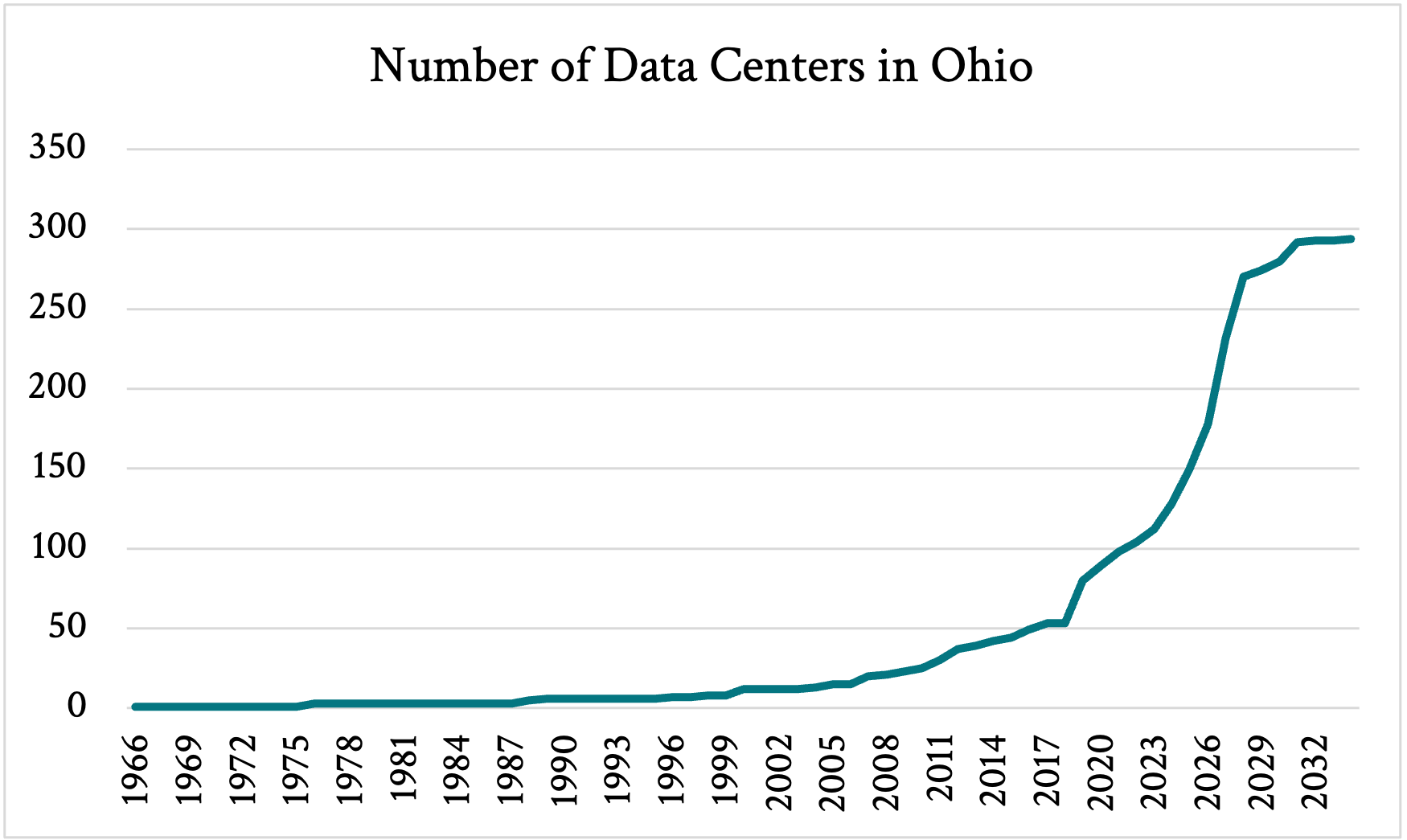
If anything, the next several years is likely an underestimate, as there may be more data centers that will be planned and developed in Ohio in the next several years that aren’t yet announced (unless Ohio residents vote for a ban on data center development).
In addition to the total number of data centers in Ohio, the size and energy capacity of data centers is increasing exponentially as well. The number of hyperscale facilities, defined as data centers that take up at least 100,000 square feet of physical space and an energy capacity of 100 megawatts or more, is growing rapidly.
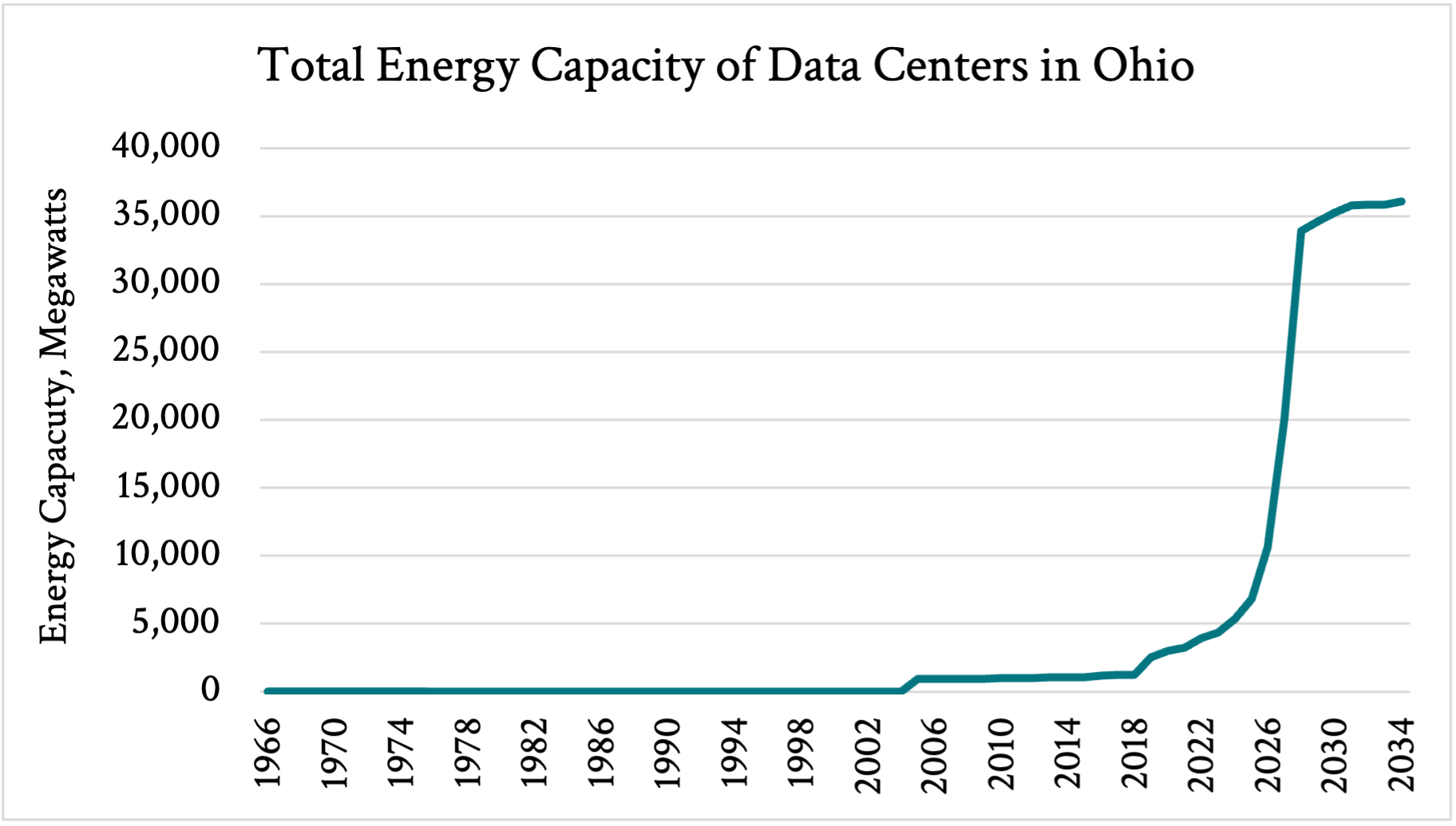
By 2034, Ohio is projected to have at least 36,000 megawatts of data center energy capacity across the state. 36,000 megawatts could power 28.8 million homes, which is 6 times the number of households in Ohio, and 21.5% of the number of households across the entire United States.
As data center growth continues, development will be a balance of competing interests: demand for digital services and artificial intelligence, environmental concerns, and local community priorities. Navigating these trade-offs requires us to weigh immediate capital gains against broader societal external costs and long-term resource availability. Evidence-based policy analysis is the key to understanding these tradeoffs moving forward.
This fall, Scioto Analysis will be releasing a cost-benefit analysis of existing and planned data center projects in Ohio to give policymakers and communities a clearer picture of the economic and environmental impacts of data centers across the state.