
Nonprofit organizations have a range of stakeholders. To persist as an organization, they need to demonstrate their value to funders. To comply with governance responsibilities, they have to demonstrate the value of their work to board members. And many have missions that extend into the policy world, making them need to demonstrate their value to policymakers. Traditional performance measures like revenue and number of people served only tell part of the story of a nonprofit organization and its impact. Social return on investment analysis is an approach that translates the impacts of a nonprofit program into economic value, putting the benefits of a program on equal footing for assessment alongside its costs.
What is social return on investment (SROI) analysis?

Social return on investment analysis is a formalized analytical approach developed to measure how the economic benefits of a program compare to its economic costs. The core output of a social return on investment analysis is a program’s “benefit-cost ratio,” which is defined as the economic benefits generated by a program divided by the economic costs of the program, both expressed in dollar terms.
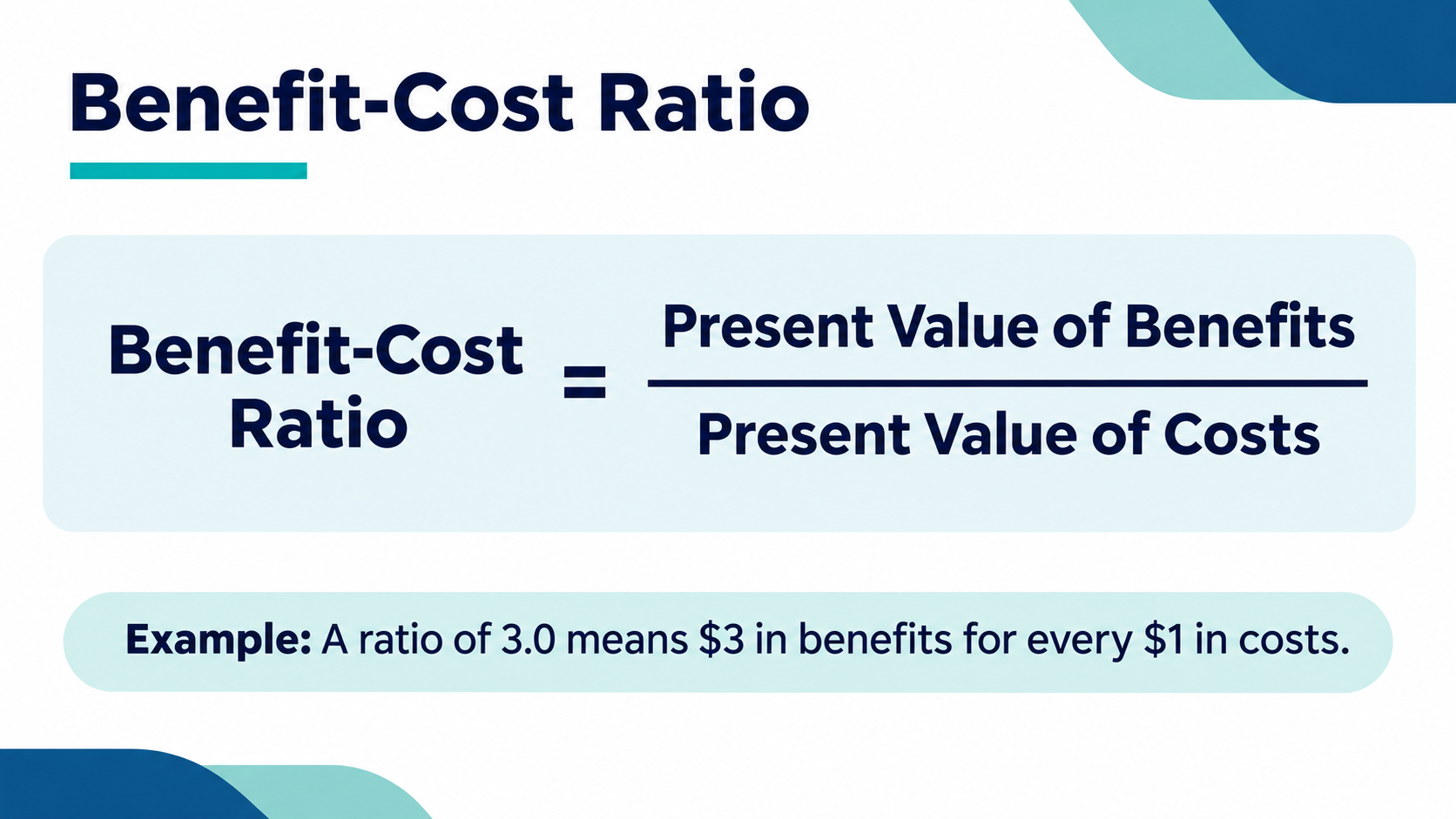
Notice how I use the word “economic” as a qualifier here. This is to draw a distinction between financial and comprehensive social costs. The goal of a nonprofit is not to maximize revenue compared to its expenditures, it is to maximize its social impact relative to its expenditures. This means going outside of the organization and seeing how its programs impact the broader community, including beneficiaries and other community stakeholders who would not traditionally show up on financial statements.
Why should nonprofits measure social return on investment?
Many nonprofit leaders are in charge of their nonprofits because they already deeply believe their programs work. If you are reading this article, you are likely in that camp. What is the point of measuring social return on investment if you already know a program works?
One reason is to communicate value to funders. Funders are often balancing competing requests from nonprofits that conduct a range of programs. Helping cut through the noise in a language that funders understand–return on investment–can help distinguish an effective nonprofit program from others. This also includes public sector funders like state and local governments, and can be applied beyond to non-funder stakeholders like volunteers and community partners.
A second reason is for internal decision making. A social return on investment analysis can help with internal resource allocation and can even expose weaknesses in a program that can make it stronger and even more impactful if addressed. In this way, social return on investment can help a nonprofit leader better manage their organization and further its mission better than they would be able to do otherwise.
How do you calculate social return on investment?
Social Value International has a great guide to social return on investment that is worth checking out if you want to dive into social return on investment methodology. The Social Value International approach to social return on investment comes down to six steps.
Establish scope and identify stakeholders. In this step, analysts define the boundaries of the program, whose benefits and costs will count, and will identify who key stakeholders are. This is about setting the stage for the social return on investment analysis and making sure the analysis is as comprehensive as possible up front.
Map outcomes. This is where analysts identify and value inputs then map outputs and outcomes of programs. Social return on investment analysis is ultimately about the social impact of a program, so tracing the impacts all the way through to outcomes is necessary for full accounting of program impacts.
Document and value outcomes. Analysts then see what kind of evidence there is of these outcomes and apply valuations to them. This requires assessing the impact of the program on key outcomes and then putting dollar figures to those outcomes.
Establish impact. This is where analysts account for what would have happened without the program, how much of the impact is attributable to other factors, whether benefits come at the expense of others, and how impacts diminish over time.
Calculate the social return on investment. This step includes projecting impacts into the future, calculating the net present value and ratio, then conducting sensitivity analysis and analyzing how long it will take the program to pay off from a social perspective.
Report, use, and embed. Finally, the analysts report the impacts to stakeholders then empower their client to use the results to improve the program as it is being implemented.
What is an example of a social return on investment analysis?
In 2025, Scioto Analysis released a cost-benefit analysis of expanding a housing mobility program modeled after Families Flourish, a nonprofit that helps low-income families move to high-opportunity neighborhoods. While technically a cost-benefit analysis, this follows many of the key steps of a social return on investment analysis.
This program provides rent support and coaching for low-income families moving to neighborhoods that would otherwise be unattainable for them to live in. To analyze the program, we compared program costs to outcomes, particularly outcomes for young children, who in similar programs have had better educational and labor market outcomes down the road from moving to a high-opportunity neighborhood. We estimated that expanding the program to 1,000 Ohio families could generate $3.14 in social benefits for every $1 in social costs.
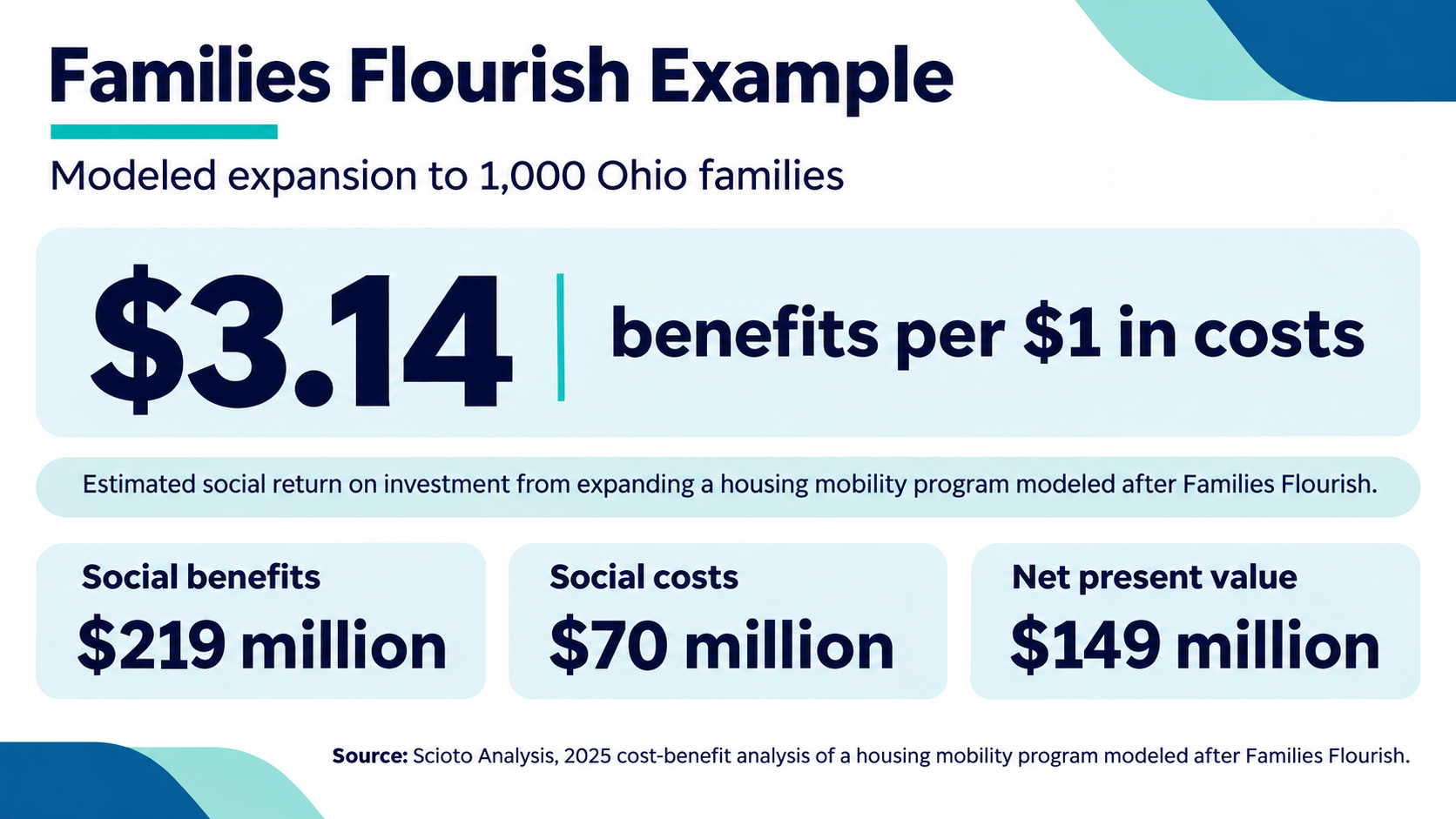
We ended up presenting these findings at a public presentation held by Families Flourish and it became a valuable resource for the organization to share the impact with stakeholders and the public.
What data do nonprofits need for a social return on investment analysis?
First and foremost, participation and expenditure data are key for a strong social return on investment analysis. While participation on its own does not demonstrate value, it is often the first step in estimating the value of a program. And expenditures are an important first step to estimating the total cost of a program.
Evidence of program effectiveness is also a key piece of data for conducting a credible social return on investment analysis. Randomized controlled trials are the gold standard for measuring program effectiveness, but credible quasi-experimental studies and research on comparable programs can also provide useful estimates of causal impacts.
Academic and administrative data are also two helpful tools for conducting social return on investment analysis. Academic data can help connect the program to the demonstrated value of similar programs. Administrative data helps analysts understand how the program works and can be used for estimating value of inputs and outputs.
This might seem daunting, but don’t let the perfect be the enemy of the good when it comes to data collection. No organization has perfect data and some data is better than none when it comes to estimating social value.
How much does a social return on investment analysis cost?
Social return on investment analysis can be done at a range of costs depending on how deep the analysis goes. A preliminary analysis using readily available data and basing impacts on existing research could be done for around $10,000. A standard social return on investment analysis of a single nonprofit program might cost between $15,000 and $50,000, depending on the scope of the study. A large-scale evaluation with surveys and interviews can easily be in the six-figure territory.
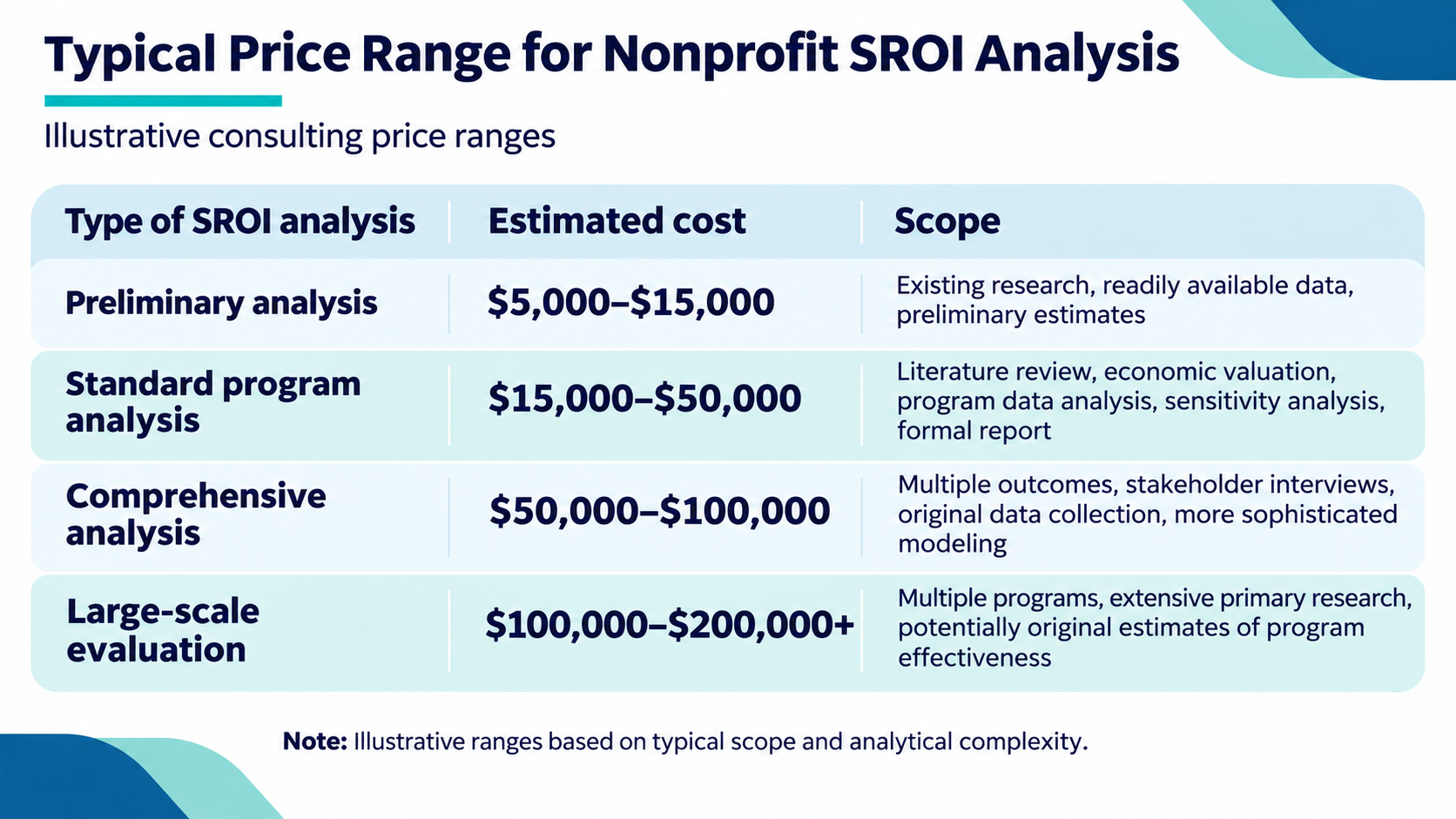
Costs are driven by factors such as data availability and the need for primary data collection, but also for factors like deliverables needed to be presented and the depth of analysis needed. A preliminary analysis will focus on a little bit of local data, mainly connecting the program to other programs that have had more comprehensive analysis conducted. More comprehensive analyses will give insight on a broader range of outcomes and will collect more original data, producing findings more specific to the program. You can learn more about pricing of policy analyses in another article I wrote recently.
When should a nonprofit commission a social return on investment analysis?
Overall, there are three questions I'd ask before when considering commissioning a social return on investment analysis.
First, am I trying to expand the program? When running a fundraising campaign or preparing grant applications trying to scale a program up, having a strong social return on investment analysis can help strengthen the case and also help you understand which parts of a program are best suited for scaling up.
Second, am I trying to make the case to someone? Having good evidence about the comprehensive social impact of a program can help speak to certain funders, public sector partners, board members, and other stakeholders who want to know what the overall impact of a program is.
Third, do I have enough of a track record to analyze? Social return on investment analysis is best carried out when a program has sufficient evidence that something has happened rather than as a theoretical program.
If you are interested in measuring the social return on investment of your nonprofit's programs, reach out to us at Scioto Analysis. We would be happy to have an initial conversation about your program, what data you already have available, what an analysis could tell you, and how much it might cost.