A couple of weeks ago, Scioto Analysis published a cost-benefit analysis of data center policies in Ohio. We found that data centers in Ohio produced a net social benefit of $62 billion between 2013 and 2026. Between 2027 and 2034, however, we project that they will produce a net social benefit of only about $2.4 billion. This is partly because data centers have strong early employment effects: a county gains most of its jobs when its first data centers are developed, and later ones add relatively few. At the same time, newer data centers are more energy intensive, so electricity use grows faster than the number of facilities. As electricity demand grows, so do the strain on the grid and the emissions from power generation. That raises costs for ratepayers and harms public health.

We estimate that 178 data centers currently operate in Ohio. If all planned projects come online by 2034, that number will rise to 294. Many of these facilities are concentrated in particular parts of the state. To better understand the benefits and costs that different areas of Ohio will see from data centers over the next several years, I wanted to look at our cost-benefit results for major metropolitan areas across Ohio.
Columbus MSA
The Columbus Metropolitan Statistical Area consists of ten counties:
Delaware County
Fairfield County
Franklin County
Hocking County
Licking County
Madison County
Morrow County
Perry County
Pickaway County
Union County
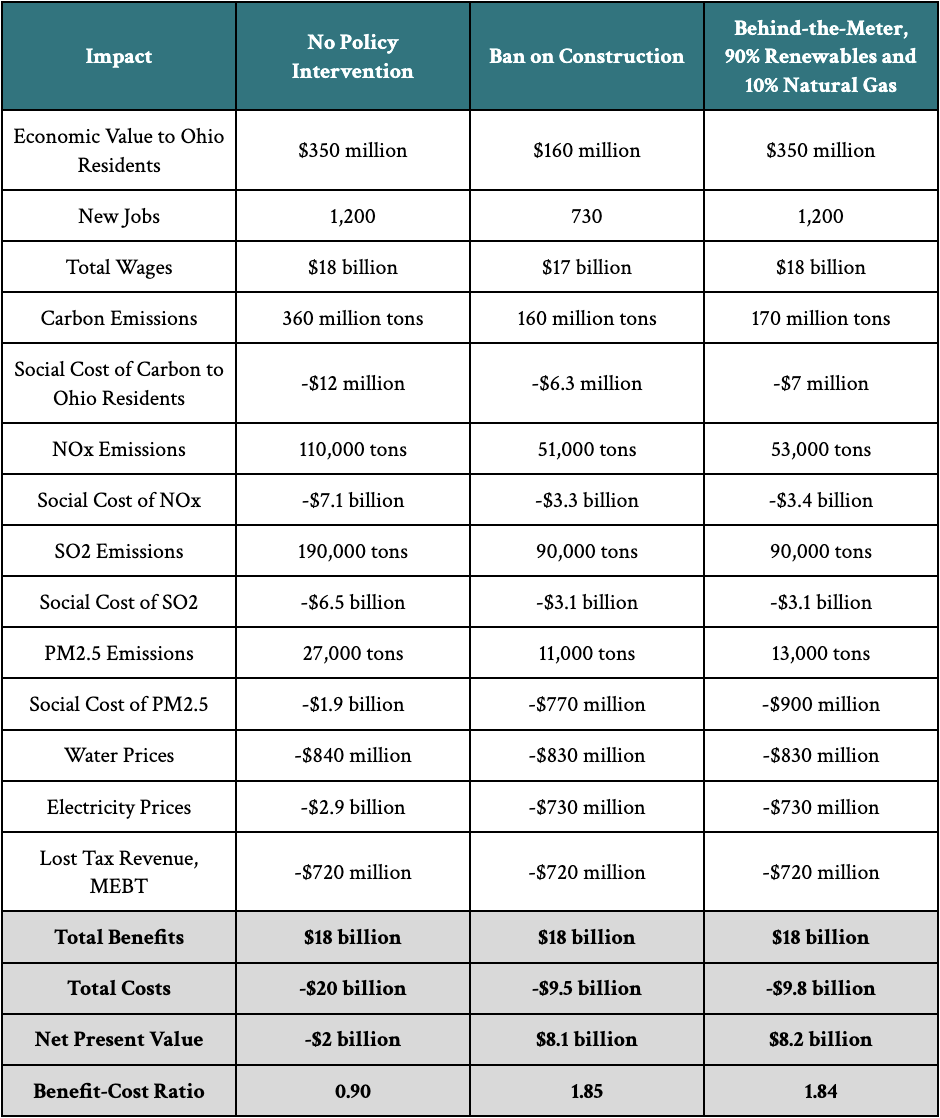
Across those ten counties, there are 106 existing data center facilities and 47 planned or proposed data center facilities between now and 2034. We estimate that these 106 data centers consume about 37 million megawatt-hours of electricity per year, an average of 350,000 annual megawatt-hours per facility. This amount of electricity could power around 3.4 million homes per year, nearly four times the number of households in the Columbus Metropolitan Statistical Area.
By 2034, we estimate that data centers in the Columbus Metropolitan Statistical Area will consume about 89 million megawatt-hours of electricity per year, an average of 580,000 annual megawatt-hours per facility. This amount of electricity could power over nine times the number of households in the Columbus Metropolitan Statistical Area.
With no policy intervention, we estimate that data centers within the Columbus Metropolitan Statistical Area have generated about $18 billion in net social value since 2013, mostly due to around 30,000 jobs supported. However, between now and 2034, we estimate that data centers within the Columbus Metropolitan Statistical Area will generate about $2 billion in net social loss, mainly due to higher electricity prices and emissions associated with electricity generation.
If future data center projects are banned within the Columbus Metropolitan Statistical Area, we estimate the net social value of data centers in the region to be about $8.1 billion between now and 2034. If future data center projects are required to generate electricity behind-the-meter, with 90% renewables and 10% natural gas, we estimate the net social value of data centers in the region to be about $8.2 billion between now and 2034, slightly higher than a ban on construction.
The table below shows the future impacts of data centers in the Columbus Metropolitan Statistical Area under each scenario.
Cincinnati MSA
The Cincinnati Metropolitan Statistical Area consists of fifteen counties, five in Ohio. There are also ten counties in the Cincinnati Metropolitan Statistical Area in Indiana and Kentucky, but we didn’t track data centers in counties outside of Ohio for this study.
Brown County
Butler County
Clermont County
Hamilton County
Warren County
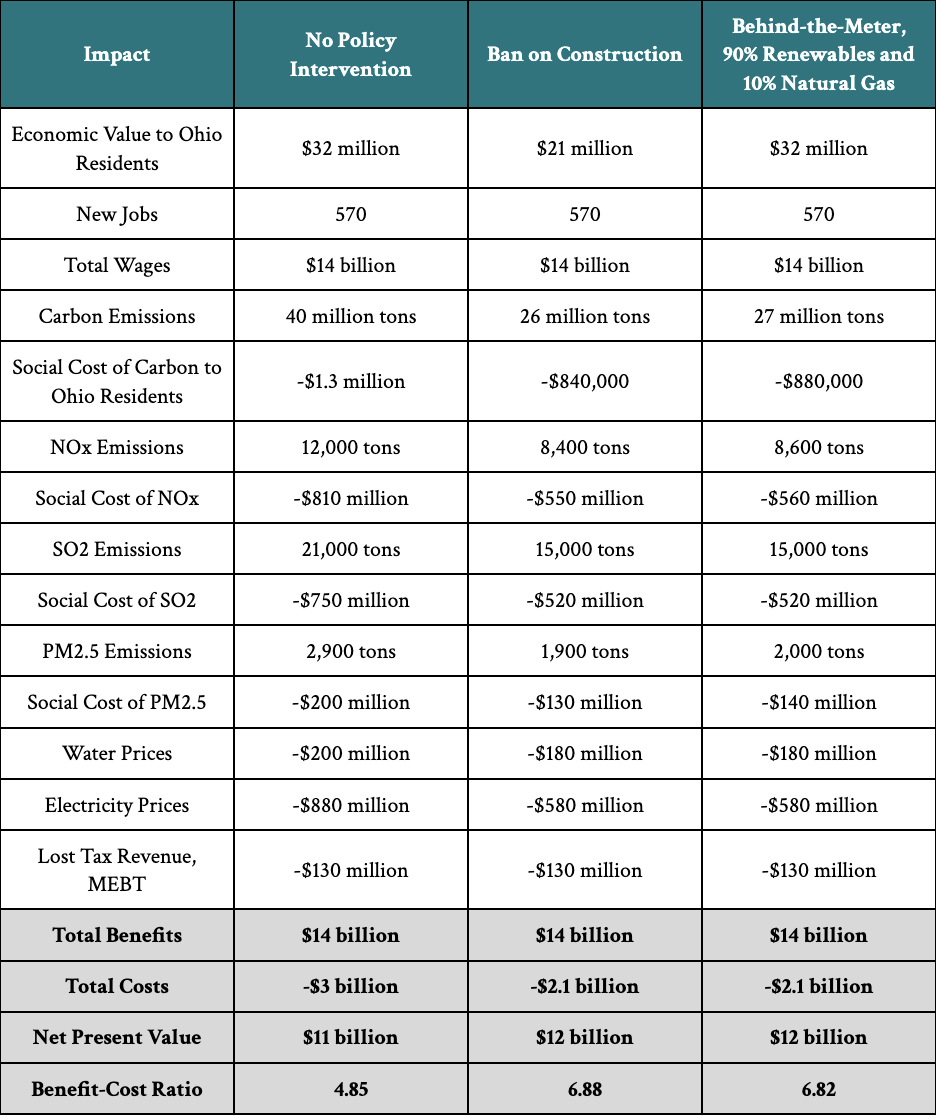
Across those five counties, there are 24 existing data center facilities and 3 planned data center facilities between now and 2034. We estimate that these 24 data centers consume about 6.1 million megawatt-hours of electricity per year, an average of 250,000 annual megawatt-hours per facility. This amount of electricity could power around 570,000 homes per year, over half the number of households in the Cincinnati Metropolitan Statistical Area.
By 2034, we estimate that data centers in the Cincinnati Metropolitan Statistical Area will consume about 9.7 million megawatt-hours of electricity per year, an average of 360,000 annual megawatt-hours per facility. This amount of electricity could almost power every home in the Cincinnati Metropolitan Statistical Area.
With no policy intervention, we estimate that data centers within the Cincinnati Metropolitan Statistical Area have generated about $21 billion in net social value since 2013, mostly due to around 24,000 jobs supported. Between now and 2034, we estimate that data centers within the Cincinnati Metropolitan Statistical Area will generate about $11 billion in net social value. The employment benefits from data centers in Cincinnati will slow down, but the utility and public health related costs aren’t as bad in Cincinnati as they are in Columbus due to slower data center growth.
If future data center projects are banned within the Cincinnati Metropolitan Statistical Area, we estimate the net social value of data centers in the region between now and 2034 will increase to $12 billion. If future data center projects are required to generate electricity behind-the-meter, with 90% renewables and 10% natural gas, we estimate the net social value of data centers in the region to be about the same as a ban on construction, about $12 billion between now and 2034.
The table below shows the future impacts of data centers in the Cincinnati Metropolitan Statistical Area under each scenario.
Cleveland MSA
The Cleveland Metropolitan Statistical Area consists of six counties:
Ashtabula County
Cuyahoga County
Geauga County
Lake County
Lorain County
Medina County
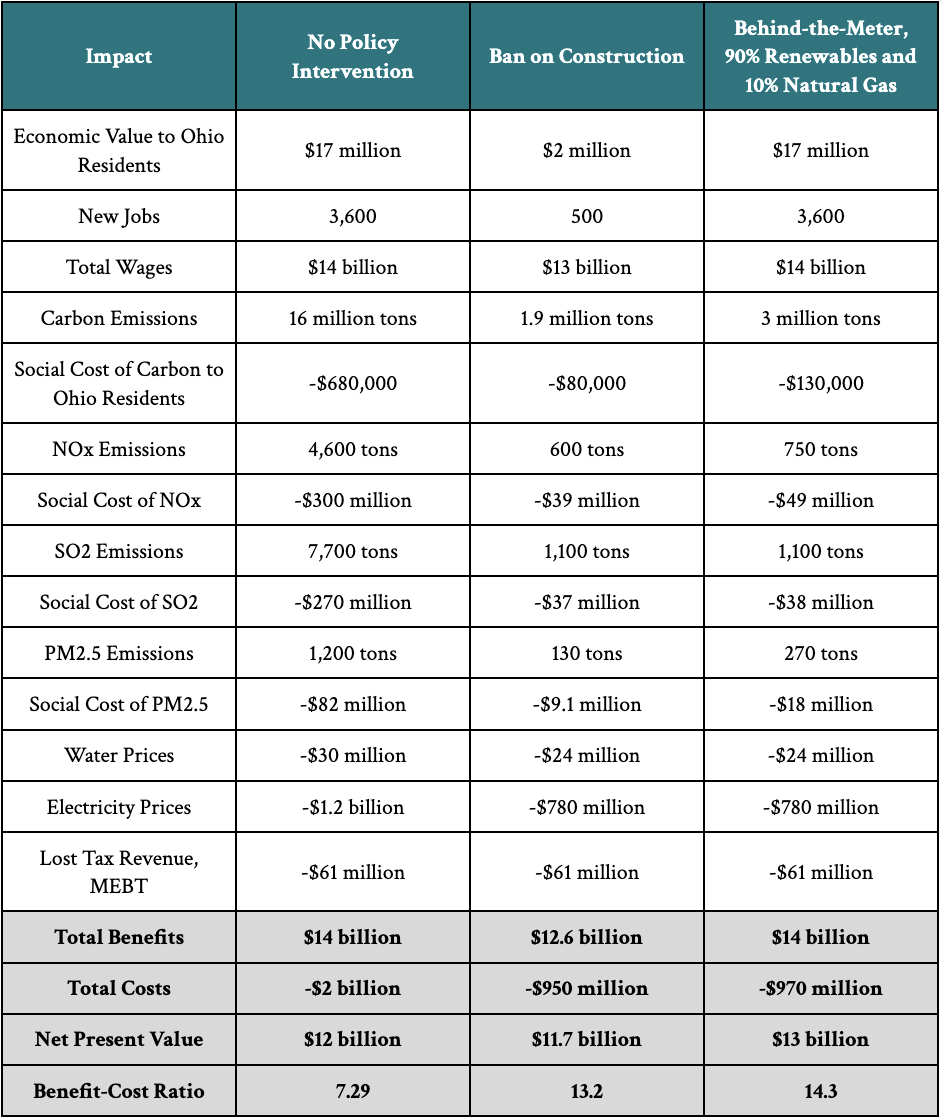
Across those six counties, there are 12 existing data center facilities and 1 planned data center facility for 2028. We estimate that these 12 data centers consume about 440,000 megawatt-hours of electricity per year, an average of 36,000 annual megawatt-hours per facility. This amount of electricity could power around 40,000 homes per year, only around 4% the number of households in the Cleveland Metropolitan Statistical Area.
With no policy intervention, we estimate that data centers within the Cleveland Metropolitan Statistical Area have generated about $21 billion in net social value since 2013, mostly due to around 20,000 jobs supported. Between now and 2034, we estimate that data centers within the Cleveland Metropolitan Statistical Area will generate about $12 billion in net social value.
The Cleveland Metropolitan Statistical Area only has one planned data center facility between now and 2034; however, this singular data center facility is massive, so its impacts are meaningful.
If future data center projects are banned within the Cleveland Metropolitan Statistical Area, we estimate the net social value of data centers in the region between now and 2034 will decrease to slightly below $12 billion. If future data center projects are required to generate electricity behind-the-meter, with 90% renewables and 10% natural gas, we estimate the net social value of data centers in the region to increase to about $13 billion between now and 2034.
The table below shows the future impacts of data centers in the Cleveland Metropolitan Statistical Area under each scenario.
What does this mean for Ohio?
If we add up the future net present values from the Columbus, Cincinnati, and Cleveland metropolitan statistical areas, we get about $21 billion in net social value over the next several years. This is much higher than the $2.4 billion net present value we calculate for the state of Ohio as a whole. This finding suggests that outside of Ohio’s three largest metropolitan areas, the future costs of data centers exceed the future benefits.
The main reason behind this is that the majority of employment benefits from data centers in Ohio are felt in Ohio’s three largest metropolitan statistical areas. According to Yue and Zeng in 2026, our source for the employment impacts of data centers, the statistically significant employment benefits of data centers are concentrated in metropolitan areas.
However, it’s also possible that employment benefits are overestimated in these core metropolitan areas. As we discuss in our full cost-benefit analysis, employment benefits are highly uncertain, while emissions costs are much more certain.
In areas where data center growth is slow over the next several years, it doesn’t appear that the costs begin to outpace the benefits of data centers. In metropolitan areas like Cleveland or Cincinnati where there are only a handful of planned data center projects, the sustained employment benefits continue to outpace the costs from electricity consumption and emissions.
On the other hand, in metropolitan areas that are experiencing rapid growth in data centers, like Columbus, we predict that the costs from electricity consumption and emissions will begin to outpace data center benefits. Local policymakers may want to consider policies such as requiring behind-the-meter electricity generation with a high share of renewable energy sources to minimize the costs of future data centers while maintaining the benefits.