
Last week, my colleague Rob wrote a blog post analyzing various taxes and how distortionary each one is. One type of tax is a user fee, which is designed to recover the cost of offering a good or service.

A classic example of a user fee is a gas tax. The only people who directly pay a gas tax are people who buy gas, and those people use the roads, bridges, and other infrastructure intended for cars. Since gas taxes are a major source of funding for this kind of infrastructure, more gas taxes paid translates directly into more funding for roads.
In theory, gas taxes aren’t distortionary at all. However, as electric vehicles become more prominent, there are more and more people who are using roads who aren’t paying into gas taxes. This presents an issue for policymakers: how do we ensure that electric vehicle owners are contributing to infrastructure for cars as much as consumers of gasoline?
What do gas taxes fund in Ohio?
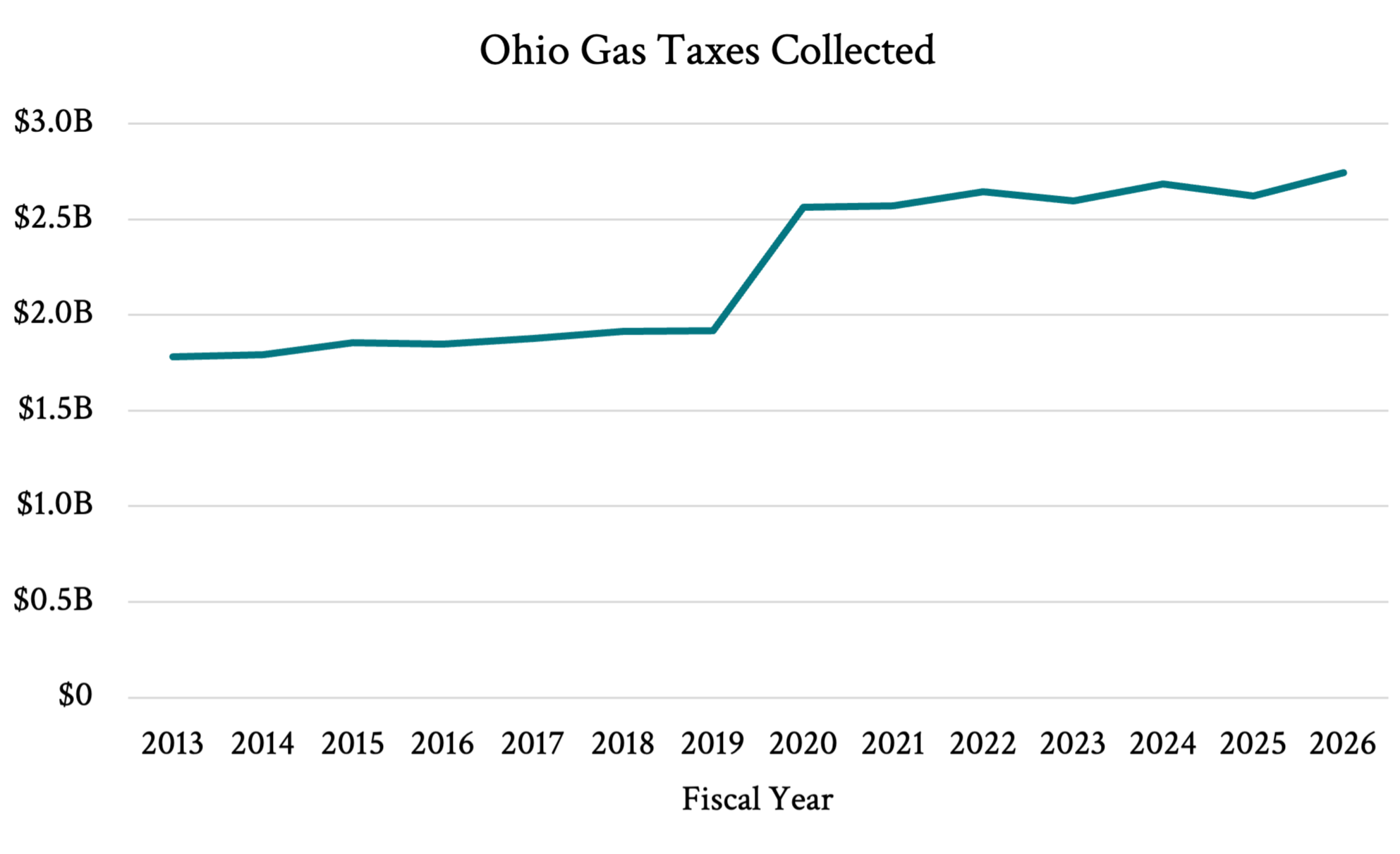
The state of Ohio charges a 38.5-cent tax per gallon on gasoline and 47-cent tax per gallon on diesel and other fuel types. If we view gas taxes in Ohio as user fees, then the 8.5-cent premium for diesel and other fuel types reflects that diesel-powered vehicles, such as trucks, buses, and other heavy vehicles, cause greater wear on roads than passenger vehicles. In 2025, Ohio collected nearly $2.7 billion in tax revenue from gas taxes.
Of that $2.7 billion, about $1.7 billion (63%) went to the Gasoline Excise Tax Fund, about $950 million (36%) went to the Highway Operating Fund, and about $34 million (1%) went to other funding sources.
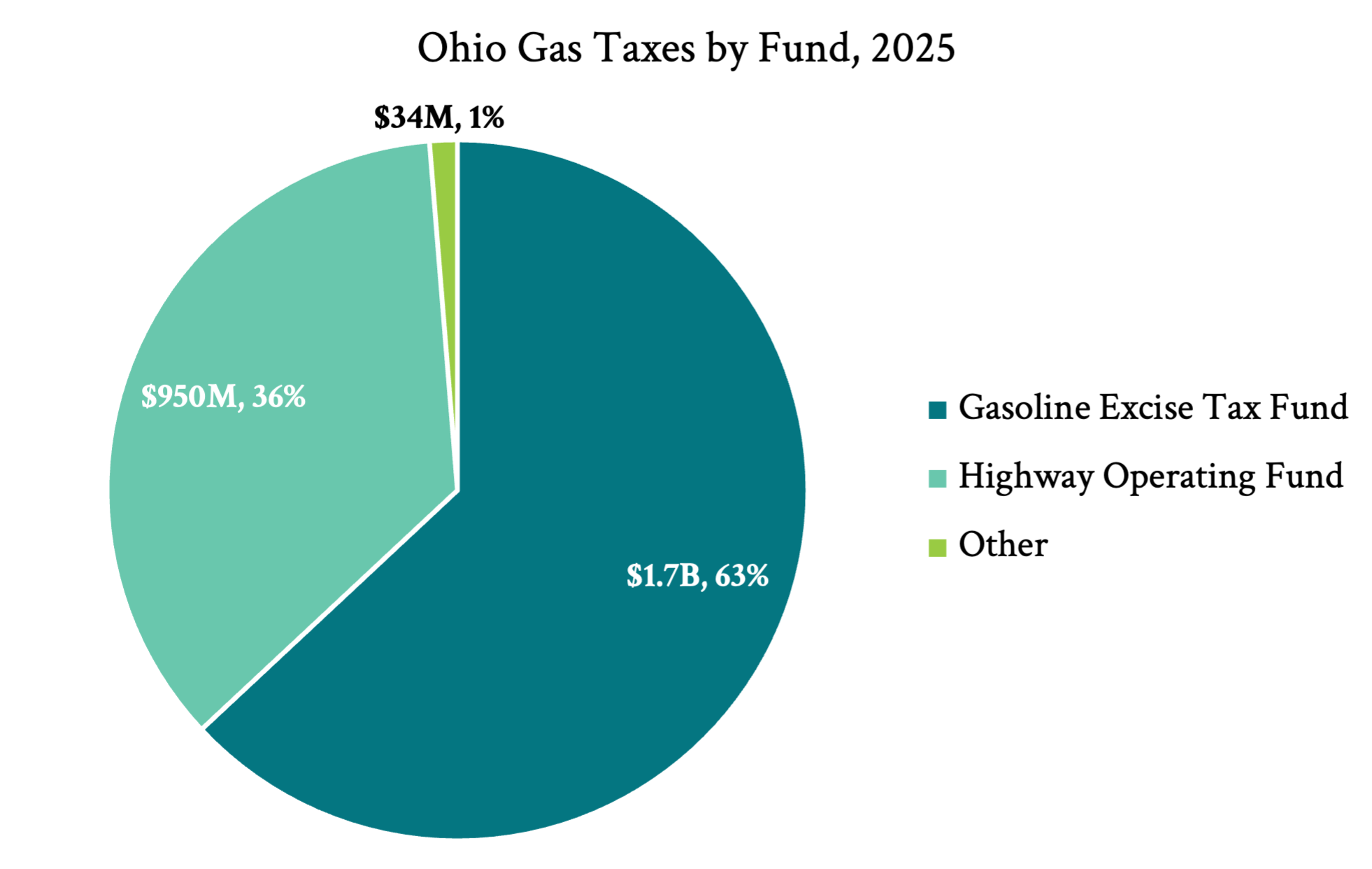
The Gasoline Excise Tax Fund is sent to municipalities, counties, and townships across Ohio for the purpose of local road projects, while the Highway Operating Fund is used for state level roads, bridges, and other statewide infrastructure projects.
Are electric vehicles becoming more common?
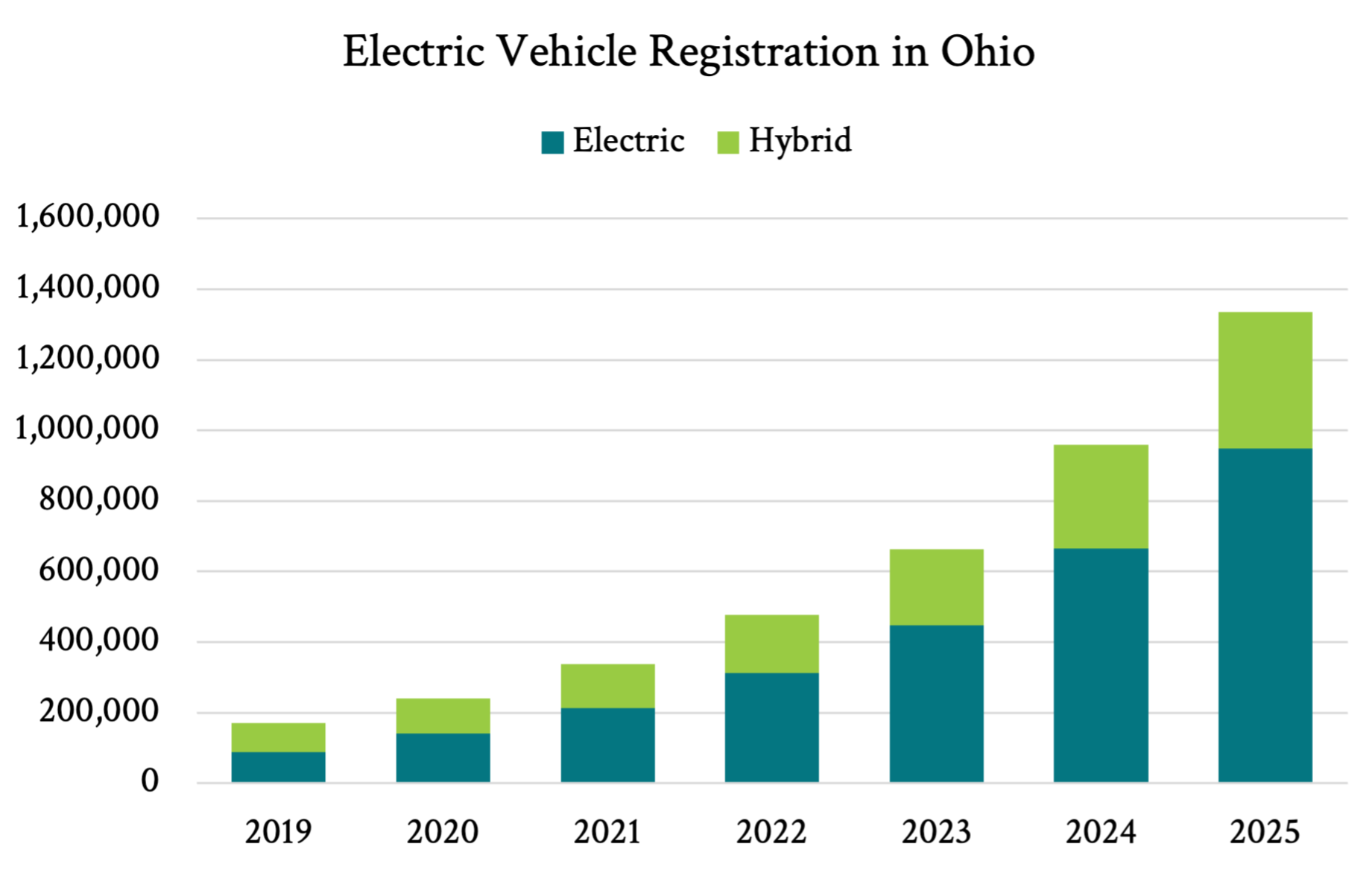
Between 2019 and 2025, electric vehicle registration increased nearly eight-fold, from 170,000 registered electric vehicles in 2019 to over 1.3 million registered electric vehicles in 2025.
As more people drive electric vehicles, relatively fewer people are purchasing gasoline. According to data from the Federal Highway Administration, the average car uses about 447 gallons of gasoline per year across the United States. That means that for each fewer gasoline car on the road every year, the state of Ohio loses about $170 in tax revenue.
Assuming each newly registered electric vehicle in Ohio between 2019 and 2025 replaced a gasoline car, and each hybrid uses roughly half the fuel of a gasoline car, Ohio loses approximately $170 million per year in gas tax revenue from the adoption of electric vehicles.
So how does Ohio recoup this money? For one, the state raised the gasoline tax by 10.5 cents and the diesel tax by 19 cents in 2019, which might have offset some of the growth in electric vehicles. However, simply raising the fuel tax places a disproportionate amount of the tax burden on drivers who still use gasoline cars.
Another way that many states are dealing with this problem is by implementing electric vehicle registration fees. In Ohio, it costs an additional $100 for hybrid vehicles, $150 for plug-in hybrid vehicles, and $200 for fully electric vehicles to renew registration each year. These prices are about in line with the amount of gas tax revenue that the state loses per electric vehicle, so these registration fees are fairly equal gas tax replacements for electric vehicle drivers.
However, a flat-rate fee paid each year doesn’t fully replace the functionality of a user fee. With a gas fee, drivers are charged according to how much gas they purchase, which roughly reflects their annual usage of roads. Registration fees for electric vehicles don’t reflect the amount that drivers use roads, so it is a less precise user fee. Some electric vehicle charging stations have taxes per kilowatt hour of energy used, which better reflects the usage of electric vehicle drivers, though private residences are exempt.
Ideally, this problem can be fixed with a vehicle miles traveled fee, which some states are currently implementing. One of Scioto Analysis’s first studies was on how new technologies are making vehicle miles traveled fees more possible. If states like Ohio can successfully implement vehicle miles traveled fees, they will be able to bring user fees closer to an efficient mimicry of a market.