

According to politicians across the spectrum, there is currently an affordability crisis in the United States. Consumer prices across most categories of goods and services continue to rise month to month, though they have slowed since the height of inflation in 2022. The cost of housing is one of the biggest factors driving increases in cost of living across the country, with a median of 31% of household income for renters being spent on rent and a median of 21% of household income for homeowners being spent on mortgages in 2024.

As housing prices continue to rise in 2025, more people are falling behind on paying their utility bills. Between 2024 to 2025, annual past due balances to utility companies increased by 9.7%, while monthly energy bills increased by 12%. If renters and homeowners hope to follow the age-old guideline of spending no more than 30% of income on housing–a threshold the median renter already exceeds–income must follow suit and rise alongside the cost of living.
In Ohio, the cost of living continues to rise as well, though there may be some upside compared to the nation as a whole. To afford a modest two-bedroom apartment in 2025, an Ohio resident must make at least $22.51 an hour working full-time, an 8% increase from last year. Simultaneously, the average Ohio renter earns just $18.62 an hour, and homelessness in Ohio has risen by 3% since 2024 to 11,759 people.
In Ohio, the cost of living continues to rise as well, though there may be some upside compared to the nation as a whole. To afford a modest two-bedroom apartment in 2025, an Ohio resident must make at least $22.51 an hour working full-time, an 8% increase from last year. Simultaneously, the average Ohio renter earns just $18.62 an hour, and homelessness in Ohio has risen by 3% since 2024 to 11,759 people.
If home prices are so much lower in Ohio than most of the United States, how do actual monthly housing costs compare? We can use data from IPUMS, a database that provides American Community Survey microdata, to answer this question. In 2023, the median gross rent including utilities across the United States was about $1,448 per month. How do monthly housing costs in Ohio compare to the nation as a whole?
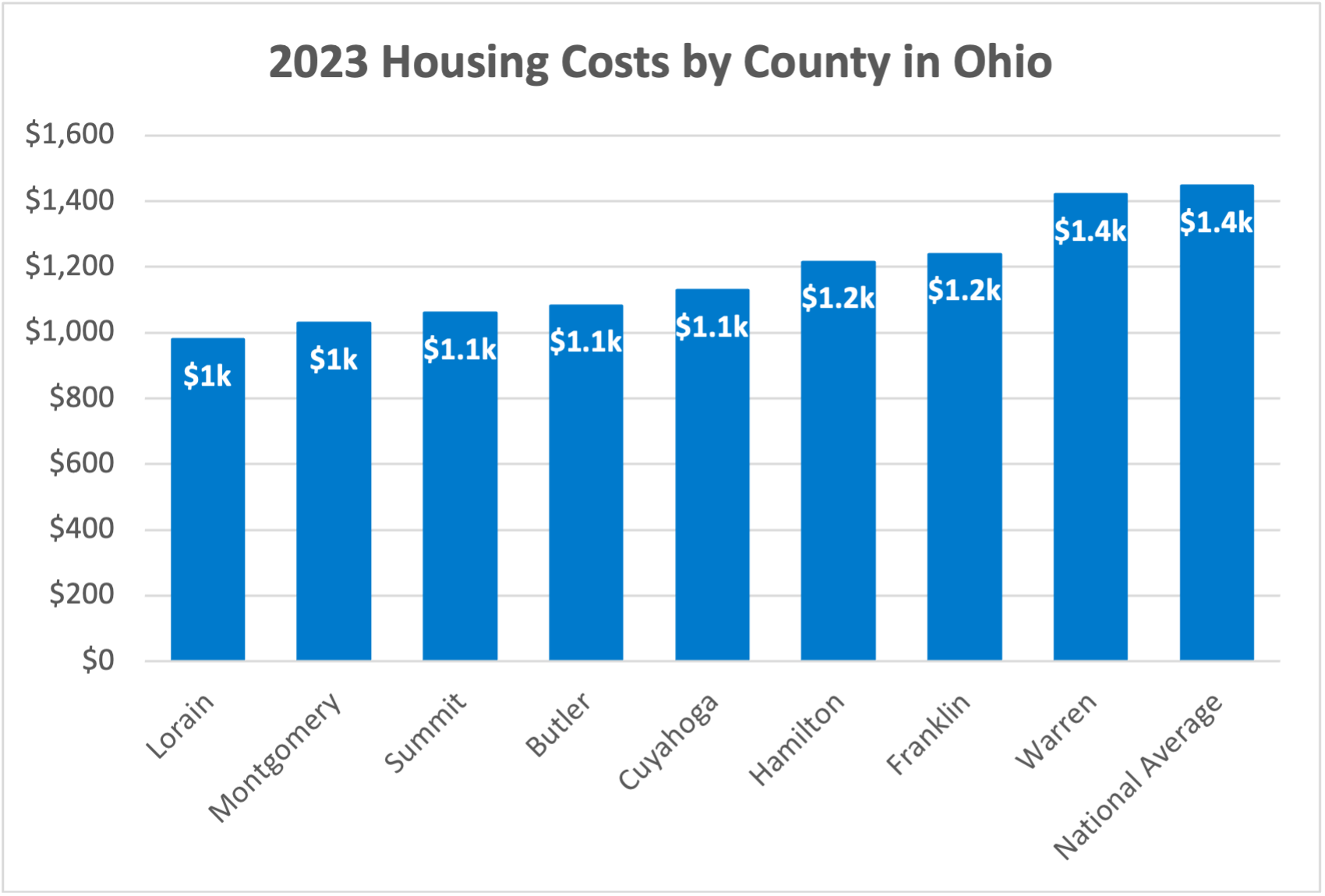
Compared to the national average, monthly housing costs across eight of the largest counties in Ohio are all lower than the national average. My economic intuition would be that Ohio’s relatively low cost of housing compared to the national average, especially in major cities such as Cleveland (Cuyahoga County), Cincinnati (Hamilton County), or Columbus (Franklin County), would incentivize workers and families nationwide to move into Ohio. On housing alone, the median renter could save $2,400 to $4,800 per year, all while still living near a major city.
However, data from the Census Bureau tells us the opposite story: between 2020 to 2024, Ohio experienced a negative net migration rate, ranking 39th out of net domestic migration rates across all 50 states. If states like Ohio are so much cheaper in a time of an affordability crisis, why aren’t people moving to them?
One possible explanation could be that lower housing costs are a facade for higher commuter costs. In 2024, a typical household in Ohio spent about 27% of their yearly income on transportation costs, mostly from car ownership, which is 5 percentage points higher than the national average and 12 percentage points higher than the recommended threshold of affordability. In Ohio, the median household income in 2024 was $72,212. Let’s say an average household moves from an average city in the United States to a city with lower housing costs in Ohio. They may see up to $4,800 dollars back in their pockets from the reduced cost of housing, but they’ll also be spending around $3,600 more per year on transportation costs.
There are a range of other price differences that impact affordability across the United States. For example, some people live in food deserts–areas where access to grocery stores and nutritious food may be limited. In these cases, consumers may have to choose between paying low prices for food or getting their proper nutrition. Another example is childcare affordability: some states, like Ohio, have far fewer subsidies for public childcare, making the cost of childcare a larger burden on household budgets. Or, some states and municipalities could have lower or higher income tax, sales tax, or property tax. In many cases, affordability differences like these muddy the waters of where actually is affordable in the United States– and which cities are the most affordable for certain demographics.
The regional price parity index from the Bureau of Economic Analysis provides reliable estimates of the differences in cost-of-living across different states. States like Arkansas, Mississippi, and South Dakota are among the most affordable, while states like California, New Jersey, and Hawaii are among the most expensive.
Regardless of how cost-of-living differences look statewide, the nuances of how an individual family spends their money are an important factor in how affordable or costly living in a particular city is. And we haven’t even touched on the opposite side of the equation here: income. No matter how affordable a state is, employment opportunities with high incomes will drive migration trends as much or even more than affordability. That is why Arkansas, Mississippi, and Ohio have not become magnets for migration: despite affordability advantages for these states over coastal states, employment is still king when it comes to the economics of migration.