20 of 23 Ohio Economists Agree More State COVID Relief Would Speed Recovery

In a survey published by Scioto Analysis this morning, 20 of 23 Ohio economists agreed that the state government would optimally invest more than the proposed $1 billion in COVID relief in the form of support for small businesses, bars and restaurants, local infrastructure, and residential broadband.

In comments, economists highlighted the options for financing, with some saying federal support is a key consideration and some pointing to Ohio’s $2.7 billion rainy day fund, which has not been used yet during this recession. Other economists emphasized the importance of education and statewide broadband connectivity. Those who were uncertain or disagreed with the statement noted the insufficiency of state funds alone and the importance of targeting of funds to investments like infrastructure.

The Ohio Economic Experts Panel is a panel of over 40 Ohio Economists from over 30 Ohio higher educational institutions conducted by Scioto Analysis. The goal of the Ohio Economic Experts Panel is to promote better policy outcomes by providing policymakers, policy influencers, and the public with the informed opinions of Ohio’s leading economists.

If you would like to suggest a question for a future Ohio Economic Experts Panel, email your ideas to panel@sciotoanalysis.com.

What does state political culture mean for policy analysis?

Do different states have different “political cultures?”

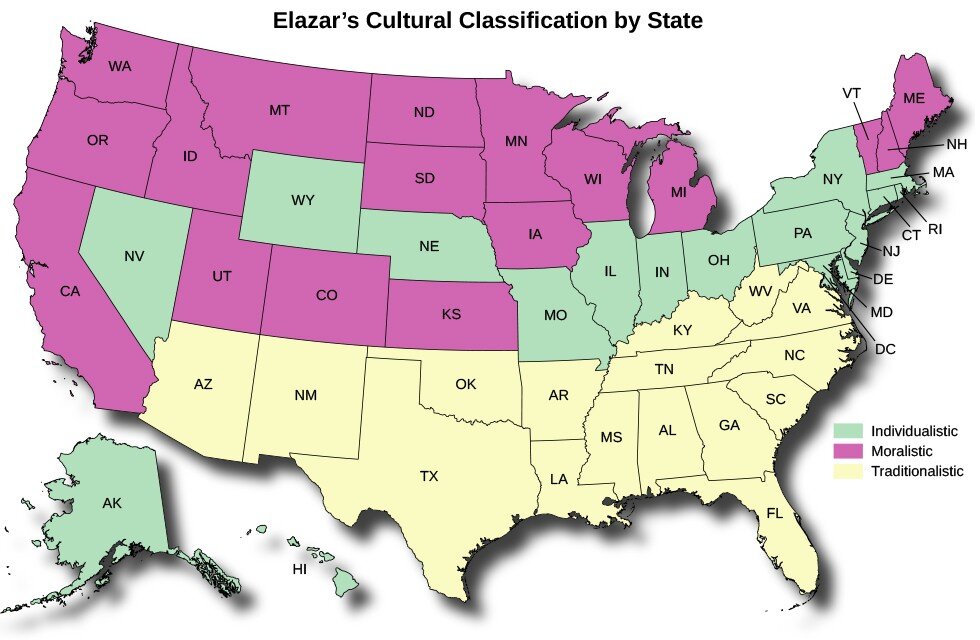
That’s the argument that is made by Daniel Elazar, a 20th-Century University of Chicago political scientist who was a leading scholar of the politics of the US states. Elazar breaks US states into three different categories: moralistic, individualistic, and traditionalistic.

According to Elazar, moralistic states are states that were settled by puritans and northern Europeans. Moralistic political culture is defined by idealism, the idea that politics can be a vehicle for solving social ills and that we can use the democratic process to find solutions for public problems. Moralistic states are concentrated in New England, Upper Midwest, and West.

Individualistic states are more cosmopolitan and diverse. Politics in individualistic states are defined by barter and negotiation, with politics being defined as a space where various factions and interests split up the pie of public cooperation. While a moralistic political culture will bring people together to the same table in order to get an understanding of a problem, the role of testimony in an individualistic political culture is to see where interests stand and to make sure they all are balanced when policy is created. Much of the mid Atlantic and lower Midwest is described by Elazar as individualistic. 

Lastly, there is traditionalistic political culture. Traditionalistic states are states that are run by elites. These states tend to be defined by one-party rule for decades on end and are run by people in the “aristocracy,” usually wealthy people who come from wealthy families. Elazar describes much of the South, Southwest, and Appalachia as “traditionalistic” in its political culture.

OSC_AmGov_14_02_Elazar.jpg

Things have changed since Elazar pioneered this typology in the 20th Century. We can argue, for example, that much of the West skews more individualistic these days. But I find it surprising how accurate this typology still seems to be. Republican governors in Vermont and New Hampshire sound a lot different from their counterparts in Southern states. There is certainly a story about partisanship here, but I think the fact that these governors have continued to win in these states against Democrats speaks to a certain moralistic pragmatism from voters.

I certainly saw this difference moving back to Ohio a few years ago from the west coast. Even local government in the Bay Area had a deep commitment to policy analysis and problem solving that seemed markedly different from the way politics is handled in Ohio. Even compared to Nebraska, which was classified as “individualistic” by Elazar, the politics in Ohio seemed nakedly transactional.

How does this impact public policy? Well, public policy is treated differently if it is seen as a problem solving exercise, a negotiating table, or a fiat of the deserved rulers. Moralistic political culture comports much more with public policy as it is taught in graduate schools, with problem definition and then construction of alternatives and analysis of these alternatives leading to policy prescriptions.

Individualistic and traditionalistic political culture can use policy analysis as well, though. How can we understand how to split the pie of public policy if we don’t know what that pie looks like? How can we have good discussions about who gets what if we don’t know what we have to divide? These are questions that are important in an individualistic political culture. In a traditionalistic political culture, rulers need to understand what they’re doing if they’re trying to advance their own interest. Policy analysis even has a place there.

Ultimately, it seems that moralistic political culture is best suited for policy analysis as we tend to define it. This could mean that policy analysts have a reason to advocate for political reforms that push politics in a more moralistic direction. It also could mean that policy analysts need to adapt to cultures that are more individualistic or traditionalistic. I’d wager that better public policy requires both modifications, deployed at different times, with a mind for the appetite that people have for change and the particular leaders in power at a particular time.

When will Ohio spend its “Rainy Day” savings?

In May of 2020, when Ohio had been plunged into recession by the COVID-19 pandemic, state budget analysts were wringing their hands trying to make ends meet in the wake of the worst fiscal crisis since the Great Recession.

Gov. Mike DeWine released a budget plan that month that cut state spending by $775 million dollars, with much of that money coming from state education spending, a sector already reeling from the COVID recession. This all happened while the state budget stabilization fund (often called the “rainy day fund”) sat untapped, $2.7 billion sitting in a state account waiting to be used.

The justification for not using budget stabilization funds, funds saved during strong economic periods to keep the budget going during economic downturns, was that “The ‘rain’ is not a passing spring shower — it could be a long, cold, lingering storm, and we should not use the fund until it is necessary.” Presumably we would need these funds down the road, so we should cut education and health spending now so we can pay for it in the future.

When DeWine released his 2021-2023 budget on Monday, though, plans for the use of the budget stabilization fund over the next two years were made public. The goal for the end of fiscal year 2022? $2.7 billion in the fund. The goal for the end of fiscal year 2023? $2.7 billion in the fund. The same as it was in May of 2020.

2020 hasn’t been as bad for state revenues as projected. It turns out that a recession that impacts high-income people less than low-income people isn’t all that bad for states that collect significant income tax. So best case scenario is that we were conservative, we pinned our ears back in 2020, and now we’re going to have this budget stabilization fund ready for the next recession when it comes along.

But tightening our belt when the economy is still down could backfire. Economists cite state and local spending as a top priority of softening the recession, yet stimulus bills have been held up because of resistance to supporting state governments

Funding state government is in some ways the most straightforward stimulus there is. We don’t need a complicated system of bank loans like the Paycheck Protection Program or the infrastructure to send a check to every household: The federal government already funds state governments every year, and states already have budget items ready to fund.

And as both children and adults return to school this year, our K-12 and higher education institutions are going to need all the resources they can get to reestablish some sense of normalcy. A majority of Ohio economists think in-person schooling will be a boon to Ohio’s economy, meaning this investment could help the economy as a whole recover.

I hope that we were just being conservative and I hope our leaders are making the right decision when it comes to the budget stabilization fund. But looking at these numbers, understanding the recession and fiscal crisis we just went through, and seeing that we spent absolutely none of the money we saved for this moment are hard truths to reconcile. If we don’t use this fund in a year like 2020, when exactly are we supposed to use it?

This commentary first appeared in the Ohio Capital Journal.

How do we get more health care workers vaccinated?

If someone is working on a construction site, we expect her to wear a helmet. I would venture to say that most Ohioans would not find anything wrong with construction companies requiring their site workers to wear helmets.

I think you see where I’m going with this. Hospital employees are not required by the state of Ohio to get vaccines, though hospitals can require their employees to be vaccinated. Many Ohio hospitals, though, are not requiring employee vaccinations.

Where is the disconnect here? Some of this might have to do with the ongoing “will they or won’t they” relationship Americans have with vaccines. The “anti-vaxxer” movement has thrived in the age of social media, with a recent report suggesting 31 million people follow anti-vaccine groups on Facebook and that anti-vaccine social media advertising is a $1 billion industry. This nervousness about vaccines has certainly impacted the comfort hospitals have with requiring vaccination, even if it will save lives.  

At the same time, hospitals are dealing with workforce fatigue. Even before the global pandemic kicked into gear, the global health care workforce was facing shortages. This can be even more acute in a state like Ohio where an older population means more demand for health care services and less supply of people to provide them.

COVID-19 has just made this problem worse. If you have friends or family in the health care industry, you’ve no doubt heard this word when you’ve asked them how they are doing: “exhausted.” Health care in Ohio throughout 2020 was a rollercoaster. Bans on elective surgeries in April forced hospitals to reduce their workforces. Then community spread throughout the summer caused mismatches in staffing as workers got sick. This all culminated in the hospitalization spike near the end of the year, which tested hospital capacity across the state.

The consideration that is likely holding back most hospitals from requiring vaccinations is a simple one: staffing. Yes, it might seem extreme to say someone would quit their job because of a safety precaution, but losing just a few staff at an already-taxed hospital can mean the difference between strain and disaster.

The state has some options for promoting vaccination among hospital staff. One is to continue to promote social distancing to keep hospitalization rates down. The governor’s continued curfews may be keeping community spread suppressed for the time being, which means less people sick and filling up hospitals and less strain on the health care workforce. Continued bans on large-group gathering and encouragement of telecommuting likely help with this, too.

On the other side, though, there are things we can do to make vaccination more attractive to health care workers. One approach is through public engagement. We’ve all seen the “Denial, Ohio” ads: The state is not afraid to spread messages about the importance of talking to your family about opioids. What about talking with your family about being vaccinated?

Brooking Institution Economist Robert Litan has gone as far as to say we should pay people to be vaccinated. Putting an extra $25, $50, or even $100+ in the pocket of a health care worker right away for getting vaccinated could be much cheaper than the Medicaid payouts for hospitalizations down the road.

If Ohio wants to beat the virus, we’re going to need to do better than 60% refusal rates for workers on the front line of the pandemic. Let’s hope that new federal leadership opens the door for new approaches that can stem the tide of this virus.

This commentary first appeared in the Ohio Capital Journal.

Majority of Ohio Economists Surveyed Think School Reopenings Will Help Ohio Economy

In a survey published by Scioto Analysis this morning, 19 of 32 Ohio economists agreed that Ohio's economy will receive a substantial boost as soon as K-12 schools can be safely opened in person statewide.

In comments, economists who agreed with the statement emphasized that school reopening will make it easier for parents to enter the labor force. Some also noted the impacts on future earnings of children for missing school. Economists who were uncertain or disagreed with the statement said that school openings on their own will not boost the state economy right away and that education has more significant long-term than short-term economic impacts.

In addition, the survey asked economists if Ohio's economy would be substantially stronger today if state and local ‘stay-at-home’ orders had lasted longer in the first half of last year. 25 of 32 economists were uncertain or disagreed with the statement. Economists uncertain of or disagreeing with the statement emphasized the twin problems of lack of federal coordination and individual compliance as barriers to effectiveness of state ‘stay-at-home’ orders.

The Ohio Economic Experts Panel is a panel of over 40 Ohio Economists from over 30 Ohio higher educational institutions conducted by Scioto Analysis. The goal of the Ohio Economic Experts Panel is to promote better policy outcomes by providing policymakers, policy influencers, and the public with the informed opinions of Ohio’s leading economists.

If you would like to suggest a question for a future Ohio Economic Experts Panel, email your ideas to panel@sciotoanalysis.com.

What is policy analysis?

It took me an embarrassingly long time to figure out what policy analysis was.

I recall sitting in an economics class in my first semester of my public policy analysis graduate program and asking myself “what exactly is ‘policy analysis’?” At the time, our program did not have an introduction to public policy analysis class until the second semester of the program, so first-years spent a lot of time with microeconomic models and inferential statistics but did not quite know why they were learning them. Suffice it to say things started to come together in the second semester.

The most straightforward definition is put forth by David Weimer and Adam Vining in their textbook Policy Analysis: Concepts and Practice:

Policy analysis is “client-oriented advice relevant to public decisions and informed by social values.”

By taking this definition apart, we can get a pretty good understanding of what “policy analysis” really is.

Client-oriented

Policy analysis is about helping a client. The most direct form of policy analysis is analysis conducted for policymakers themselves. This could be a legislator, a regulator, an administrator, or anyone else in the public sector. It also could be a think tank, a foundation, or even a company. The key here is that policy analysis is conducted for someone.

The client could even be yourself: if you are a policymaker who is trying to decide what decision to make and you are analyzing information, you are conducting policy analysis. But one thing that sets policy analysis apart from, say, academic research, is that it is practical: it helps someone make a decision for a pressing problem.

Advice

Public policy analysis is not a directive, it is advice. Its goal is to increase the quality of policymaking, but it is ultimately different from a process designed to discover a conclusive answer for a policy problem. Policy analysis aims instead to bring more information to the policymaking process.

Misunderstanding this aspect of policy analysis can cause people to come to misguided conclusions about policy analysis. For instance, some people fixate on the concept of “net present value” of a policy in cost-benefit analysis, a type of policy analysis, thinking this one number purports to tell whether a policy is good or bad. Net present value, though, only gives insight as to whether a policy is economically efficient. This should be useful to policymakers, but hardly gives a policymaker all the information she needs to make a decision, and even less compels her to necessarily adopt or reject a policy.

Relevant to Public Decisions 

Policy analysis is not about private problems, but about public ones. Specifically, policy analysis is about problems that are faced by the public sector.

While an analysis measuring the public impact of private electricity generation by a power company could inform a policy analysis, that analysis does not constitute policy analysis unless it asks how a public actor could impact that problem. Rather, policy analysis is concerned with the tools of the public sector like regulation, taxation, subsidies, and bodies that can use them, like public agencies and federal, state, and local governments.

Informed by Social Values

Ultimately, policy analysis has a social bent. It is about trying to solve problems in the public sector with society’s values at its core.

This is why policy analysis focuses on effectiveness, efficiency, and equity so often. It is in the public interest that policies are effective: that they work as they are intended to. Policies should be efficient: they should maximize the use of social resources. Policies should be equitable: they should promote fair outcomes among different groups impacted. Policy analysis is about trying to figure out how well a given policy promotes these social values. 

“Policy analysis” can be a slippery, vague phrase. I try to keep the above definition from Weimer and Vining close and dear so I can remember why, how, and especially what work we’re doing here at Scioto Analysis. I hope it will be a helpful guide for you as well.
The value of Ohio’s state parks

This week, the DeWine Administration announced five priorities for 2021. These focuses were fighting COVID-19, police reform, state budget, fiscal responsibility, and state parks.

State parks stand out to me as a notable inclusion on this list. While COVID-19 and police brutality have dominated headlines and state budget and fiscal responsibility are unavoidable priorities in a budget year, state parks seem like an odd choice on its face.

But in the unique year that 2020 was, state parks have been a godsend for people trying to get out of the house. According to the University of Nebraska Medical Center, walks outdoors are the lowest-risk activity people can do with people outside of their household. The Center says it is even less risky than going to the grocery store.

Ohio residents have responded to the increased dangers of crowded public spaces and mass gatherings by visiting state parks. The Ohio Department of Natural Resources Division of Parks and Watercraft said the number of daily visitors to Ohio’s state parks has risen dramatically during the pandemic, with weekends last spring rivaling typical summer visitation and midweek visitation up as well.

Because of the reduction of options for activities, the value of state parks to individuals has increased during the COVID-19 pandemic.

State parks are free to visit in Ohio, which makes them a public good in the economic sense of the phrase. Crowding, though, can make them scarce. If parking space runs out at a park, it no longer becomes a public good, but a limited commodity.

The value of state parks does not stop at the private benefits to individuals, though. Also important are the public benefits that state parks provide. 

For instance, state parks help preserve Ohio’s ecological heritage. After over a century of deforestation following American settlement of Ohio, Ohio’s forestland has grown in the past fifty years, in part because of the growth of its state park system.

Public parks can also improve the quality of groundwater, which is a particularly bad problem in the state of Ohio. More miles of streams and river undisturbed by residential, industrial, and commercial activity means more miles running through forests and wetlands, which improves outlook for water quality in the state as a whole.

Another public value of state parks is public health. State parks are a relatively cheap investment for improving public health, promoting physical activity, which is a strong preventative measure for health impacts down the road. Park attendance on its own has health benefits, too, with a Penn State University study showing visits to parks associated with less stress, lower blood pressure, and higher perceived physical health. Investments made in parks can be much cheaper than public spending on health complications down the road.

Something to note, however, about the value of state parks, is that their value is not necessarily enjoyed equally by people across the state. While data on demographics of visitors is scarce, state parks are often inaccessible to people with lack of access to transportation and national data shows parks are disproportionately visited by non-Hispanic whites.

State parks have value to individuals, the environment, and public health. Hopefully, the Governor’s highlighting of this public good leads to a more effective and equitable park system in the future.

This commentary first appeared in the Ohio Capital Journal.

Is $8.80 the right minimum wage for Ohio?

As the Ohio Capital Journal reported last week, Ohio’s minimum wage will rise to $8.80 per hour next month.

According to the United States Department of Labor, Ohio’s current minimum wage of $8.70 per hour is higher than most of its neighboring states. Indiana, Kentucky, and Pennsylvania all have minimum wages pegged to the federal minimum wage of $7.25 an hour. Meanwhile, West Virginia’s minimum wage is at about the same level as Ohio’s while Michigan’s is highest in the region at $9.65 per hour.

While the conventional economic wisdom for years was that minimum wage increases hurt low-wage employment, a 1993 study of New Jersey’s minimum wage increase in 1992 started to unravel this consensus. The study found that fast food restaurants in New Jersey saw no change in employment compared to restaurants in eastern Pennsylvania after the adoption of a minimum wage increase.

Why did this happen? This is what economists have been trying to figure out since.

One theory economists have is that local employers have “monopsony power” that keeps wages artificially low. What is a monopsony? Well we all know a monopoly is when there is one producer who produces a certain kind of good. Because you can only get this good from one place, the producer can jack up prices and consumers have to pay more than they would in a competitive market.

A monopsony is when there is only one consumer of a good, in this case labor. Because the consumer of labor has market power to flex, it can keep wages low compared to a competitive labor market and actually increase profits. 

So a town that has a few dozen different retail businesses have more options for work, the businesses have to compete with each other for labor, and wages stay competitive. In a town where Walmart is the only employer, the retailer can keep wages lower than they would be in a competitive market and stay profitable.

In situations where employers are exerting market power to keep wages artificially low, a minimum wage increase can push wages up, both helping workers without risking increases in unemployment.

Despite these reasons to be optimistic about minimum wage increases, the CBO still projects that minimum wage increases would likely result in some new unemployment, increasing unemployment negligibly for a $10 minimum wage but increasing by over a million workers with a $15 minimum wage.

Minimum wages in the United States are much lower than other countries. Australia, France, and United Kingdom all have minimum wages that exceed 50% of the per capita GDP. If Ohio matched this minimum wage level based on its GDP, its minimum wage would have exceeded $12 an hour in 2019. A more localized approach could have minimum wages vary on a county-by-county basis. For instance, 50% of GDP per capita in Cuyahoga County would be over $19 an hour while in Vinton County it would only be a little under $6 an hour. 

Is $8.80 the right number for Ohio? It seems better than $7.25, but likely leaves people in poverty who wouldn’t be there otherwise. With the amount of attention minimum wages have received across the country, maybe it is time for Ohio to reconsider its own.

This commentary first appeared in the Ohio Capital Journal.

Ohio Economists Think School Funding Reform Will Substantially Reduce State Inequality

In a survey published by Scioto Analysis this morning, 26 of 30 Ohio economists agreed that a more equitable state school funding formula would substantially reduce inequality in the state of Ohio in the coming decades.

While the majority of respondents agreed a more equitable funding formula would substantially reduce inequality, a number of economists stated that the degree of the impact would be contingent on broader investments and smart use of funds.

Of the four economists who did not agree with the statement, three agreed more equitable school funding would reduce inequality, but were uncertain whether that reduction would be substantial, explaining that other factors will also be important in reducing inequality.

Last month, the Ohio House of Representatives passed a bipartisan bill to reform school funding in the state. The Ohio Senate has declined to take up the bill this year, but components of the bill will likely be a factor in budget negotiations next year. Advocates say House Bill 305 will make the state school funding formula more equitable.

The Ohio Economic Experts Panel is a panel of over 40 Ohio Economists from over 30 Ohio higher educational institutions conducted by Scioto Analysis. The goal of the Ohio Economic Experts Panel is to promote better policy outcomes by providing policymakers, policy influencers, and the public with the informed opinions of Ohio’s leading economists.

If you would like to suggest a question for a future Ohio Economic Experts Panel, email your ideas to panel@sciotoanalysis.com.

Should we use benefit-cost ratios or net benefits to make decisions?

If you’ve seen a cost-benefit study reported or talked about in passing, you’ve probably heard a phrase that sounds like some sort of variation of “for every dollar you put in, you get $X out.” In cost-benefit, this is what we call a “benefit-cost ratio.”

Why do we use benefit-cost ratios? Well, they are intuitive. If you get more dollars out than you put in, sounds like a good deal, no? So benefit-cost ratios help us communicate a core insight from cost-benefit analysis.

Another use for benefit-cost ratios is in trying to figure out how to allocate a limited budget. If a government has limited funds and cannot increase its revenue, benefit/cost ratios are a great way to compare programs.

For instance, if a state government is doling out money for tackling substance abuse problems and a local government is trying to figure out how to spend it, local policymakers can turn to the Washington State Institute for Public Policy’s benefit-cost tables for substance abuse and order the programs from highest benefit-cost ratio to lowest. They can then eliminate low-yield programs and use a mixture of higher-yield programs, or if funds are very limited, just choose one of the programs has a higher benefit-cost ratio.

So if benefit-cost ratios have so much value, why do cost-benefit analysis textbooks and professors emphasize a different way of communicating cost-benefit results—"net benefits”—so much?

First, let’s establish what net benefits are. While a benefit-cost ratio is calculated by dividing benefits by costs, net benefits are calculated by subtracting costs from benefits.

Benefits / Costs = Benefit-Cost Ratio 

Benefits - Costs = Net Benefits

So let’s say, for instance, that a county government was entertaining a proposal to implement a pre-k program that would generate $4 million in social benefits and $1 million in social costs. In this instance,

Benefits / Costs = $4 million / $1 million = 4 benefit-cost ratio

Benefits - Costs = $4 million - $1 million = $3 million of net benefits.

So what do people like about net benefits? Well, what matters is when net benefits diverge from benefit-cost ratios.

Let’s use an example here. Say a state legislative leader is trying to make a big impact in the world of education. She finds that a state universal early childhood education program would yield a little over $3 in benefits for every dollar invested and would help students enrolled to the tune of about $15,000 per student enrolled. Conversely, she finds that Second Step, a program for aggressive children, yields over $5 in benefits for every $1 invested but likely will impact a lot less children and will have a lower per-child impact as well at just about $500 in benefits per child. 

If the legislator wants to raise a small amount of money, Second Step might be a better program. If the legislator is willing to raise the large up-front costs for universal pre-k, the net benefits will justify that revenue, even if it is more expensive to generate those dollars.

Ultimately, both measures are beneficial. Benefit-cost ratios are easier to explain, but they also don’t paint the whole picture. Cost-benefit studies would do well to include both of these results so policymakers can utilize a more full understanding of the policy when making a decision about what to fund.