
Have you ever stopped to wonder what ultimately happens to things you flush down the toilet? If you are like me, probably not. Or, to the degree you have ever paid any mind to the fate of your waste, you probably know that it ends up at a wastewater treatment facility. But what happens after it has been treated there? The answer, in many places around the U.S., is that it gets renamed and spread onto farmland.

For decades, this practice has been widespread across the U.S. Recently, though, this once-obscure corner of waste management practice has become a live issue for state legislatures and environmental agencies across the country. As concerns about contaminants in processed sewage waste have grown, states have begun taking a much closer look at what exactly is being spread onto their land and what should be done about it.
What are Biosolids, and Where and Why Do We Use Them?
Biosolids are the official term for what remains of waste after it has been processed and treated at a wastewater treatment plant. The liquid components of sewage are separated from the solids, then the solids are treated physically and chemically, resulting in biosolids. Biosolids are also commonly referred to as sewage sludge.
Under Environmental Protection Agency rules, biosolids may be used on forests, parks, golf courses, rangelands and more; however, it is most commonly applied to agricultural land.
Biosolids can improve the soil, making farms more productive while costing farmers very little, since the biosolids are generally provided by waste systems for free. The practice also comes with environmental benefits. Applying biosolids sequesters carbon in soil and reduces demand for phosphorus-based fertilizer, which is non-renewable but necessary for crops.
Moreover, biosolid waste has to be disposed of somehow. Recycling waste by applying it to land generates fewer greenhouse gas emissions than other options, such as burning the waste or dumping it in landfills would. It also saves public dollars which would otherwise need to be spent on these forms of disposal.
States vary in how much biosolids they apply to agricultural land.
Comparison: What Percentage of Biosolids are Applied to Agricultural Land by State?
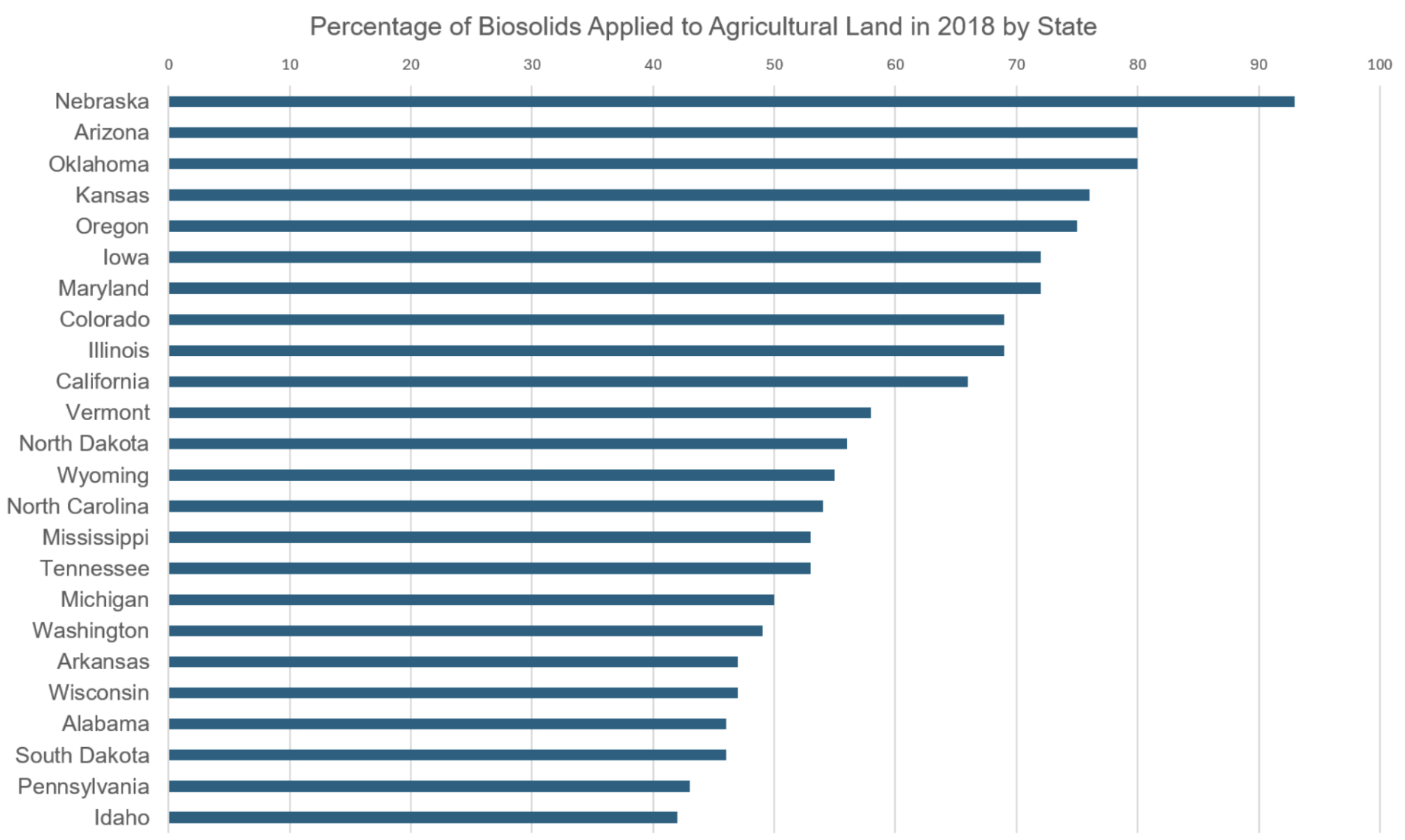
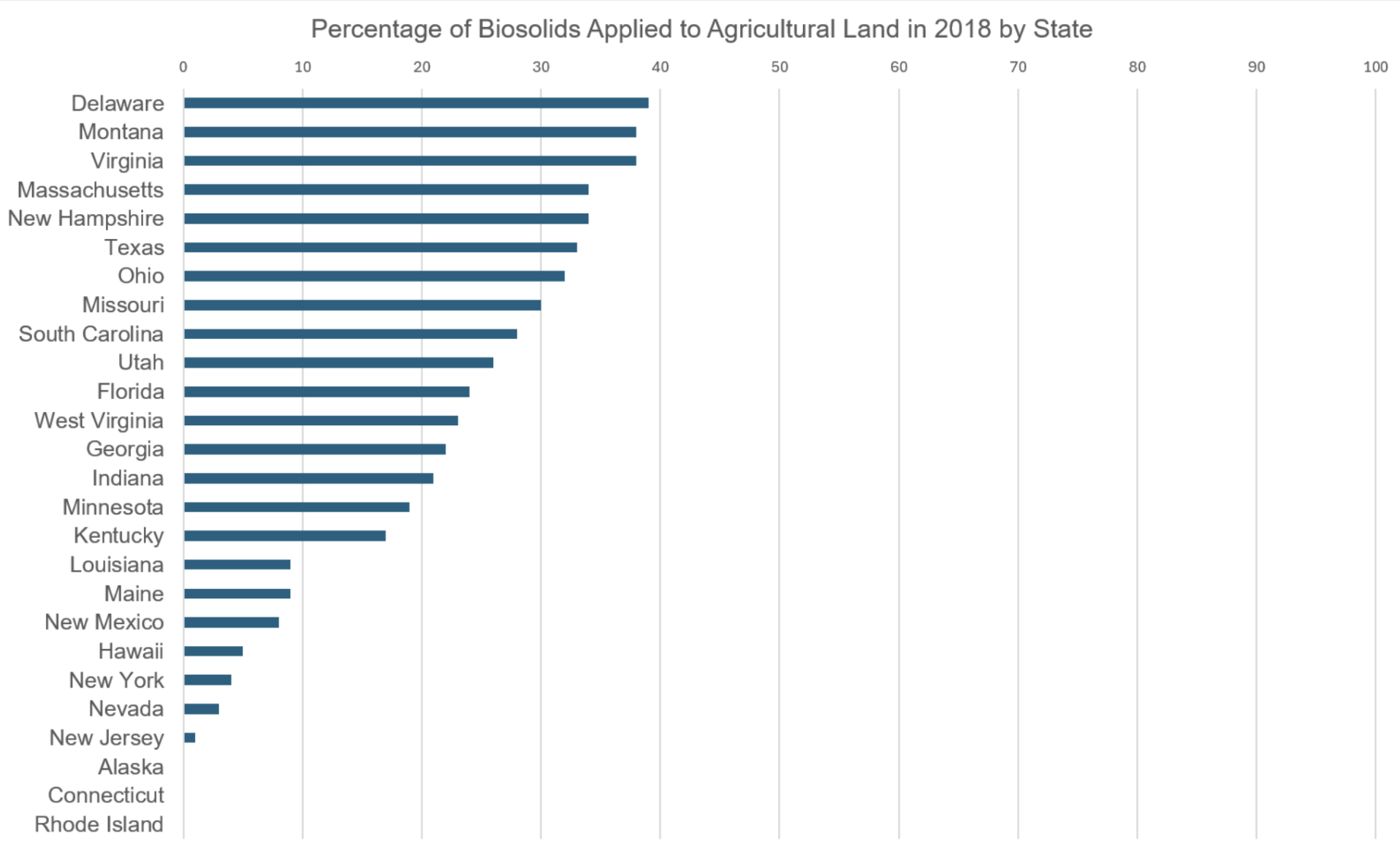
Chart Data: National Biosolids Data Project
Per- and Polyfluoroalkyl Substances (PFAS) in Biosolids
Since 1993, the Environmental Protection Agency has required biosolids applied to land to be processed under standards which includes requirements on sanitizing the waste for pathogens and sets maximum levels for metal contamination. In a September 2000 report, the Environmental Protection Agency cited the main issue of public concern over the practice as being the unpleasant smells people believe biosolid application will produce in their neighborhoods.
In the decades since, however, more substantial concerns have emerged. A 2013 study tested biosolid waste nationwide and found widespread contamination of chemicals known as “PFAS.” Subsequent research found similar results.
What is “PFAS?”
PFAS is an umbrella term for thousands of related chemicals which have been widely used in industrial processes and consumer products since the 1950s. All PFAS have a carbon-fluorine bond in their chemical makeup. This type of bond is particularly strong, and that property means these chemicals do not break down easily. This trait is what earned them the nickname “forever chemicals,” as it gives them their tendency to persist in the environment.
PFAS’ presence in biosolids used for land application constitutes a public health concern because PFAS exposure has been linked to increased risks of kidney, prostate, and testicular cancers, increased cholesterol, low birth weight, accelerated puberty in children, and other negative health outcomes.
Policy Responses to Biosolid Contamination Problems
The Environmental Protection Agency states that due to these risks, it is taking steps to research and remediate biosolids PFAS contamination. The agency recommends that states monitor their own biosolids for PFAS in the meantime and work to identify industrial sources of the problem.
States across the U.S. have responded to this guidance from the Environmental Protection Agency in different ways, with some moving beyond monitoring and source identification.
Testing and Threshold Approaches
States in this category are closest to the Environmental Protection Agency’s recommendation for policy to minimize the harms of PFAS in biosolid re-use. They are testing biosolids for PFAS, and in many cases certain levels of contamination trigger source identification efforts. Some states go further, forbidding or limiting the amount of biosolids which can be applied to land if PFAS is detected above a certain threshold.
Colorado
In 2023, Colorado’s Department of Public Health and Environment began requiring biosolids preparers to monitor for PFAS contamination. If the level of perfluorooctanesulfonic acid (one specific type of PFAS, which Colorado uses as an indicator of more general PFAS contamination) detected exceeds 50 parts per billion, preparers are required to contact Colorado’s Department of Public Health and Environment and conduct an investigation into the contamination source.
Maryland
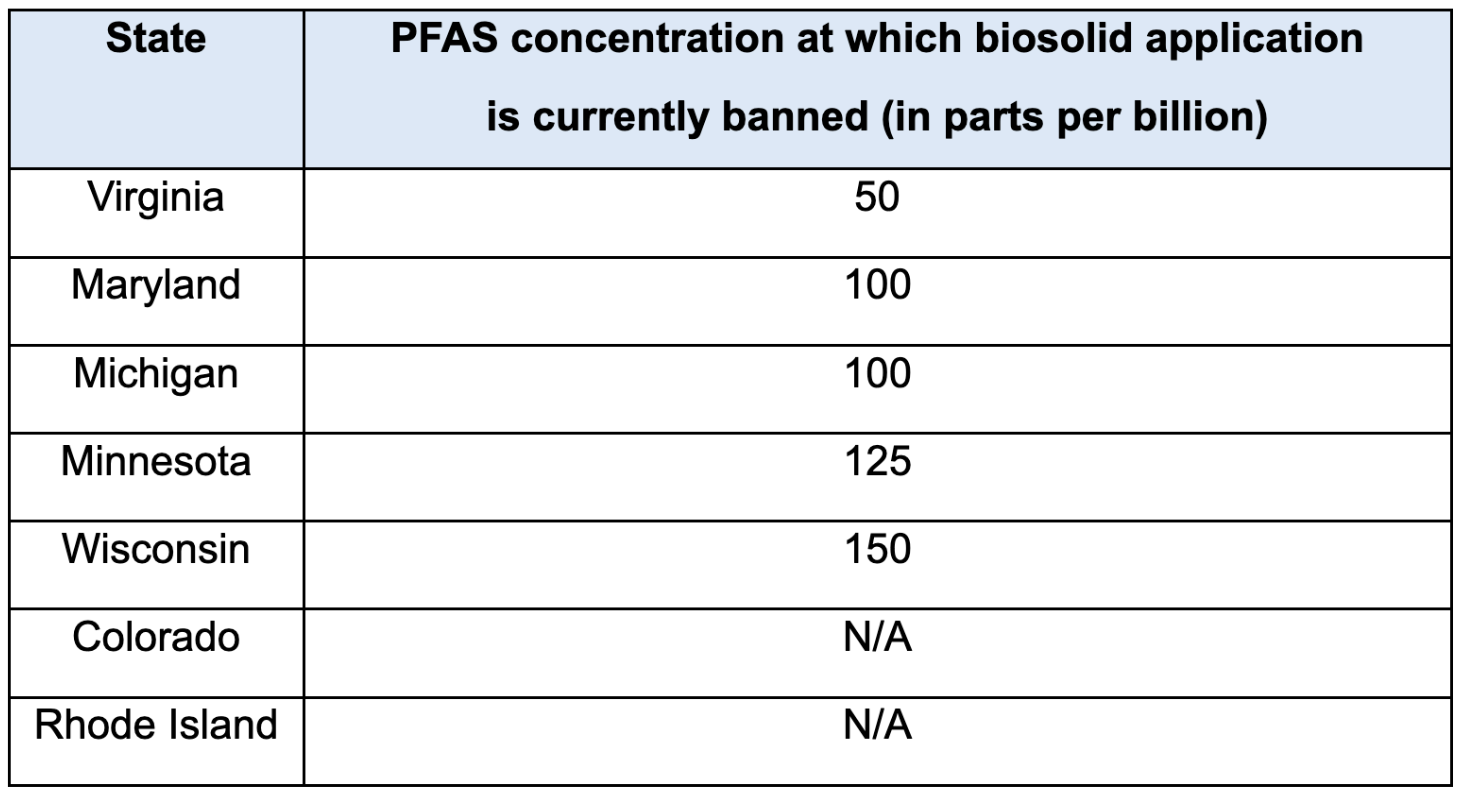
In 2024, Maryland’s Department of the Environment began requiring wastewater treatment plants to test for PFAS contamination. If the level found exceeds 100 parts per billion, the waste is prohibited from land application. If PFAS concentrations are 20-99 parts per billion, there are limits on how much biosolid may be applied per acre of land.
In 2026, Maryland updated these rules with the passage of Senate Bill 719. The new law restricts PFAS concentrations in biosolids used for land application to 25 parts per billion. Treatment facilities are required to develop mitigation and monitoring plans if their biosolids are found to have PFAS concentrations over 50 parts per billion. The new law will take effect in 2028.
Michigan
Michigan began a policy of testing biosolids for PFAS in 2021 and amended their approach in 2022 and 2024. Biosolids with PFAS contamination above 100 parts per billion are currently prohibited from land application use. Levels between 20-99 parts per billion trigger a source investigation and limits on how much biosolid can be applied per acre of land.
Minnesota
In 2025, Minnesota’s Pollution Control Agency released a strategy requiring wastewater treatment facilities which intend to apply biosolids to land to test for PFAS. If contamination greater than 125 parts per billion is detected, land application is not allowed and the source of the contamination must be investigated. Samples with 20-124 parts per billion may still be applied, with limits on how much can be used per acre of land. These samples also require a contamination source investigation.
Rhode Island
Rhode Island has an existing permitting process for anyone wishing to apply biosolids to land. In 2025, the state enacted a law requiring PFAS test results on the biosolids be included as part of the permit application. Those holding permits will also be required to furnish test results quarterly. No specific contamination threshold for rejection was outlined in the law.
Virginia
In 2026, Virginia passed a bill which will phase in testing for PFAS in biosolids. Wastewater treatment facilities will be required to test for PFAS, and if concentrations are found to be greater than 50 parts per billion, biosolids may not be used for land application.
Wisconsin
In 2024, Wisconsin’s Department of Natural Resources issued an interim strategy which requires biosolids to be tested for PFAS. If concentrations above 150 parts per billion are found, land application is not allowed and an investigation into the source of the contamination is required. If values are between 20-149 parts per billion, an investigation into the source should be performed, but application is still allowed, with limits on how much biosolid may be applied per acre.
Differing Thresholds by State
Bans on Biosolid Application
These states have banned the practice of biosolid land application through new state laws.
Connecticut
In 2024, Connecticut passed PA 24-59, which banned the use and sale of biosolids for land use. The state had already prohibited direct land application of biosolids, so the new law primarily addressed commercial biosolid fertilizers and soil amendments which the earlier ban did not cover.
Maine
In 2022, Maine became the first state to ban biosolid land application entirely.
Legislation to Study Contamination
This policy choice commits states to studying the levels of PFAS contamination for a period of time before moving forward with any future potential actions.
Washington
In 2025, the State of Washington enacted a law which requires facilities to test biosolids for PFAS between January 2027 and July 1, 2028, and supply results to the state. The law requires that the data be used to produce a report to the state legislature which will include recommendations on future legislative action.
Pending Legislation
Several states have introduced legislation which could alter their policy regarding biosolid land application. Some legislatures are working to introduce moratoria on biosolids land application, while others are attempting to establish PFAS monitoring practices.
Florida
During the 2026 legislative session, Florida’s legislature approved a bill which would require wastewater treatment facilities to test for PFAS quarterly and submit results to the Florida Department of Environmental Protection. If signed into law, this bill will take effect on July 1, 2026.
Illinois
Illinois’ Senate Bill 3917 would introduce monitoring requirements for PFAS in biosolids. The bill passed both the Illinois House and Senate and is currently awaiting the Governor’s signature.
New Hampshire
New Hampshire’s House Bill 1275 would impose a 5-year moratorium on the application of biosolids for agricultural use if passed into law.
New York
Senate Bill S9115A was introduced in the New York State Senate in 2026. This bill would establish a five-year moratorium on biosolid land application and require PFAS testing and reporting for biosolids. It is currently scheduled for a vote on the New York State Senate floor.
New York’s Department of Environmental Conservation already requires sampling of all biosolid sources and sets thresholds for acceptable concentrations. If levels above 20 parts per billion are not brought to less than 20 within one year of detection, biosolid use from that source is prohibited.
Where State Policies May Go Next
In the absence of a uniform federal standard, states are likely to continue developing their own approaches tailored to their local political environments, degree of local PFAS contamination concerns, and competing waste management and agricultural priorities. The result is a rapidly evolving policy patchwork across the U.S.
A core concern for those choosing to ban or heavily restrict biosolids application is what to do with all the biosolids waste otherwise. In Texas, House Bill 1674 was introduced in 2025. The bill would have regulated the use of biosolids as land fertilizer, but it ultimately failed in part due to opponents’ concerns about how much other disposal methods would cost wastewater utilities. Maine’s experience has proven those concerns are not unfounded. Since their outright ban of biosolid land application in 2022, nearly all biosolid sludge in the state now goes to one landfill. The landfill has applied for an expansion to accommodate the influx, but the process has been stalled by an appeal from a conservation organization concerned about the waste’s PFAS concentration polluting a nearby river.
Owing to these concerns, source control efforts may become more important to regulatory responses in the coming years. Michigan, Minnesota, Colorado, and Wisconsin all have policies which focus on identifying the sources of the PFAS contamination. If these states are successful at reducing PFAS in waste before it reaches wastewater treatment plants, they may be able to mitigate the public health risk without banning land application of biosolids, and other states may be able to follow suit in setting their own policies.