
Over the past several months, Americans across the country have been feeling the strain of rising gas prices. Living in Columbus, Ohio, I felt it firsthand last night when it cost me over $50 just to fill up my small sedan. With local prices sitting around $4.99 per gallon, this month is on track to be the second most expensive month for gas in Ohio history. The only other times we've seen prices get anywhere near this high were during the summer of 2022, where gas prices were priced similarly primarily due to Russia’s full scale invasion of Ukraine, and back during the 2008 recession. This raises the question– why are gas prices in Ohio starting to reach record high levels?
Why are gas prices rising?

Every year, gas prices tend to rise during the spring and early summer months. This is partially due to oil refineries switching from their winter-blend fuel to summer-blend fuel. Due to warmer weather, cars don’t need the fuel to evaporate as easily to start up. Instead, summer-blend fuel focuses on keeping emissions and smog low to meet various state and regional requirements. On top of that the demand for gas is higher during spring and early summer months, which can sometimes increase gas prices by 10 to 15 percent.
This spring, gas prices have been rising at unusually high rates. Over the past several weeks, the United States and Iran have been conducting naval blockades of the Strait of Hormuz related to their ongoing conflict. A quarter of the global seaborne oil supply passes through the strait, so blockades result in oil prices skyrocketing. Although the United States doesn’t import much oil from the Middle East, domestic prices for crude oil and gasoline are still reliant on global price trends since crude oil is traded at such high volumes in the global market.
The conflict between the United States and Iran has now been happening for more than two months. Peace talks are underway, but it’s unclear whether or not the Strait of Hormuz opening back up this summer will significantly ease gas prices throughout the rest of the year.
How expensive are gas prices now?
As of May 3, 2026, the national average price for gas is about $4.45 per gallon. Average gas prices by state can be found in the table below.
| Gas Prices by State | |
| State | Gas Price |
|---|---|
| California | $6.10 |
| Washington | $5.67 |
| Hawaii | $5.63 |
| Oregon | $5.25 |
| Nevada | $5.17 |
| Alaska | $5.04 |
| Illinois | $4.93 |
| Ohio | $4.89 |
| Michigan | $4.87 |
| Indiana | $4.83 |
| Arizona | $4.74 |
| Connecticut | $4.52 |
| Pennsylvania | $4.52 |
| District of Columbia | $4.48 |
| Idaho | $4.46 |
| New York | $4.45 |
| Colorado | $4.44 |
| New Jersey | $4.42 |
| Vermont | $4.42 |
| Maine | $4.40 |
| Utah | $4.39 |
| Rhode Island | $4.38 |
| Wisconsin | $4.37 |
| Florida | $4.34 |
| New Hampshire | $4.34 |
| Massachusetts | $4.34 |
| Montana | $4.32 |
| Wyoming | $4.30 |
| West Virginia | $4.30 |
| Maryland | $4.27 |
| Kentucky | $4.22 |
| Delaware | $4.21 |
| Virginia | $4.17 |
| New Mexico | $4.16 |
| North Carolina | $4.08 |
| South Dakota | $4.06 |
| Minnesota | $4.05 |
| South Carolina | $4.00 |
| Tennessee | $3.99 |
| North Dakota | $3.99 |
| Missouri | $3.97 |
| Kansas | $3.96 |
| Alabama | $3.96 |
| Nebraska | $3.96 |
| Iowa | $3.95 |
| Texas | $3.92 |
| Louisiana | $3.90 |
| Oklahoma | $3.89 |
| Mississippi | $3.88 |
| Arkansas | $3.88 |
| Georgia | $3.85 |
Like always, gas prices are the highest on the West Coast, with California, Washington, Hawaii, Oregon, Nevada, and Alaska all above $5.00 per gallon. California tops this trend at a whopping $6.10 per gallon. Gas prices are often higher on the West Coast because states are farther away from suppliers. Additionally, California has especially strict regulations around the blend of gasoline permitted to be sold.
On the other hand, gas prices are currently lowest in the Deep South, with Georgia, Mississippi, and Arkansas having the three lowest prices per gallon. Southern states’ proximity to refineries along the Gulf Coast keep gas prices low alongside relatively lax state regulations around gasoline blend.
Normally, states in the Midwest face relatively low gas prices. However, following the top six most expensive states for gas which are all located in the West, Midwestern states fill the next four spots. Illinois, Ohio, Michigan, and Indiana all boast average gas prices upwards of $4.80 per gallon. On top of pre-existing global supply concerns for gasoline, Indiana and Missouri refineries are facing unexpected operational disruptions, which is driving midwest gas prices even higher.
How have gas prices changed?
Since January 20, the national average for gas prices has increased from $2.83 to $4.45 per gallon, a 57% increase. In the chart below, gas prices from January 20 until now are shown by state.
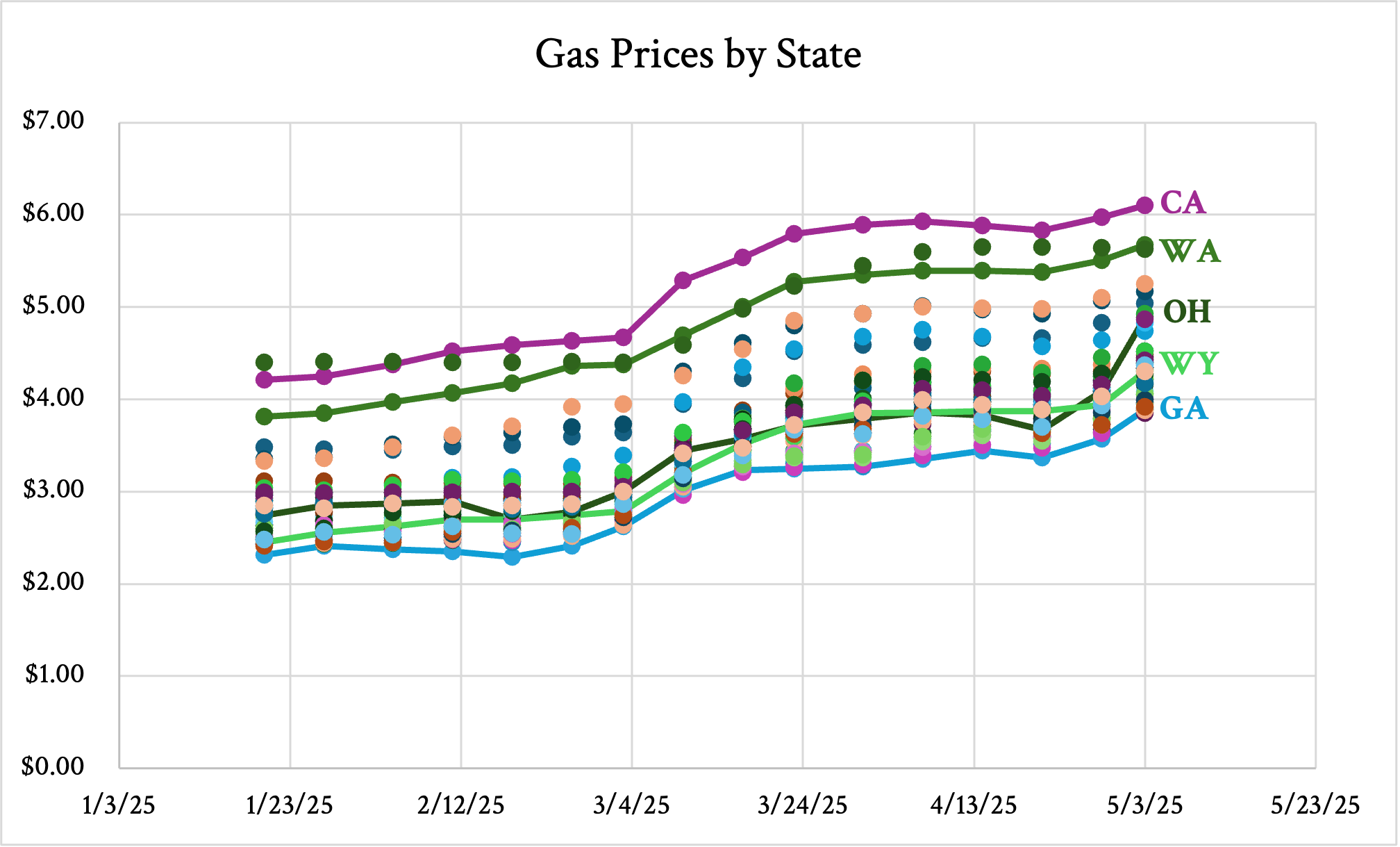
In January, 41 states had average gas prices below $2 per gallon. Now, just 13 states have average gas prices below $4 per gallon. Ohio has experienced the most dramatic increase in gas prices, a 79% increase from $2.74 per gallon in January to $4.89 per gallon now, while states like Hawaii which had already high gas prices are experiencing the lowest percent changes.
Across most states, gas prices were increasing steadily throughout February. In March, most states saw a huge jump, with gas prices leveling out the past couple weeks.
Ultimately, regional dynamics are the cause of Ohio’s gas price spike. This will likely lead to more pain for households, especially low-income and car-dependent households. This is an example of state economies being impacted by federal policy. Until the Strait of Hormuz is stabilized, states like Ohio will continue to suffer from high gas prices.