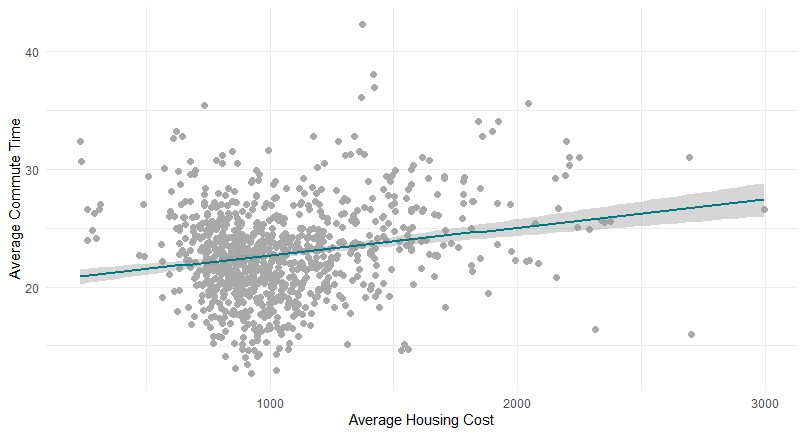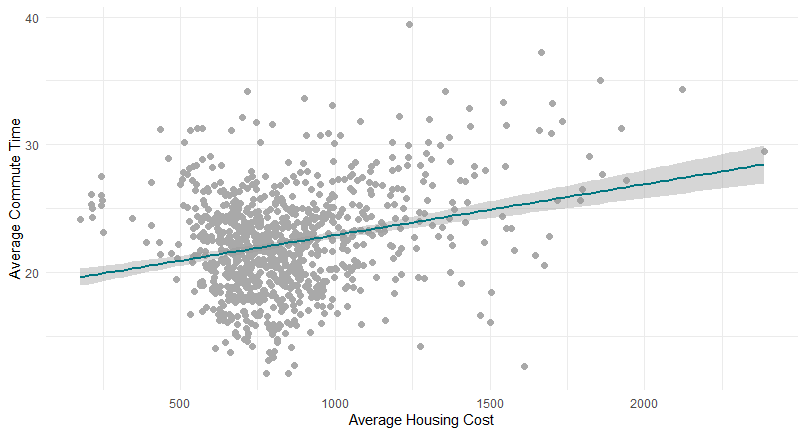

Last week, I wrote about a quick analysis I did trying to see if housing prices were related to commute times in cities across the country. Go check out that blog for the full details, but in short I found that yes, higher housing prices are correlated with longer commute times.

Commutes are a fact for most working people in the United States. According to the American Time Use Survey, Americans who have to travel for work spend an average of 45 minutes per day commuting. This means that over the course of a year, the average adult who has to travel for work spends almost 275 hours on their commute, the hour equivalent of nearly seven full work weeks.
How people commute
According to census data, the majority of workers commute by themselves in a car.
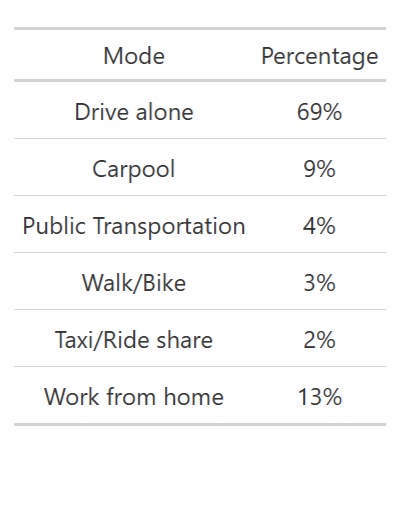
Table 1: The majority of workers drive themselves to work
The dominance of driving has important implications for both individuals and policymakers. Because such a large share of workers rely on personal vehicles, changes in fuel prices, road congestion, or highway infrastructure affect millions of people every day. At the same time, the relatively small share of workers using public transportation or active transportation reflects the reality that these options simply are not available in many parts of the country.
Cost of commuting
When considering how much commuting costs, there are a few things that we can measure. First are the direct costs associated with travel: gasoline, vehicle maintenance, parking, and pollution. These are largely straightforward to calculate and represent the costs that people see most clearly in their monthly budgets.
A less straightforward cost is the opportunity cost associated with commuting. If people didn’t spend 45 minutes per day in their cars, what else could they accomplish?
Economists think about time as a scarce resource. Every minute spent commuting is a minute that cannot be spent working, exercising, spending time with family, or enjoying leisure activities. The value of that lost time differs from person to person and understanding these tradeoffs can help us design better policies.
Differences in commuting types
This is where the tradeoffs between commute styles become apparent. A bike or walk commute may be longer than driving, but it produces less pollution and serves as a form of exercise. Perhaps for some people the additional commute time is made up entirely because they no longer have to spend time going to the gym after work hours.
There also exists the potential for people to do something productive with alternative forms of commuting. People who take buses or trains to work have the opportunity to read, answer emails, study, or simply relax during their trip in a way that someone driving cannot. On the other hand, public transportation often involves fixed schedules, transfers, and less flexibility than driving. This could lead to longer overall commute times, which has been shown to have some serious negative outcomes.
Policy implications
Different commute types have a lot of tradeoffs, and which one is best is certainly an individual question. Whether people like being able to get things done on a train, they like combining exercise with their commute, or they value the flexibility that comes from driving a car, there is no one size fits all solution.
Because of this, in a world without budget constraints policymakers should try and make it so every possible form of transportation is available to everyone. Under budget constraints however, priorities need to be established.
Those priorities should ultimately reflect the needs of the communities they serve. Dense urban areas may receive the greatest benefit from investments in public transportation, while rural communities often depend on reliable roads and highways. Likewise, improving sidewalks, bike lanes, and pedestrian infrastructure may make sense in neighborhoods where short trips are common. Rather than assuming one mode of transportation is inherently better than another, policymakers should focus on providing people with practical options that fit their circumstances.